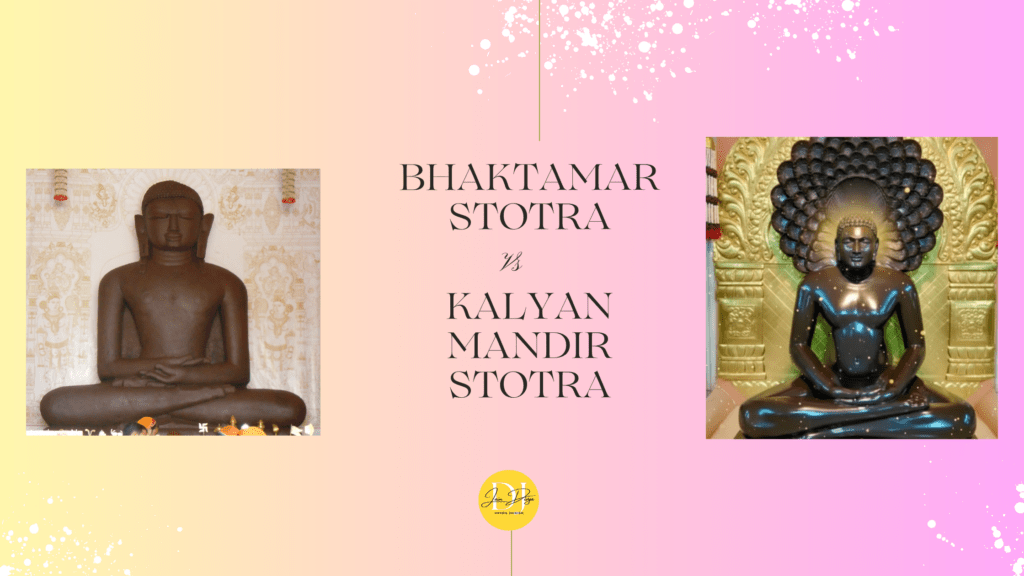
The Bhaktamara Stotra, composed by Ācārya Mānatunga, and the Kalyan Mandir Stotra, composed by Ācārya Kumudacandra, occupy a unique and exalted place in Jain devotional literature. Though dedicated to different Tīrthaṅkaras, these two hymns share deep thematic, structural, and philosophical parallels. For this reason, they are often studied together as complementary spiritual texts rather than as isolated compositions.
Both stotras go beyond poetic praise. They function as living spiritual instruments meant to transform the devotee from within.
Below are the key themes that unite these two great hymns.
1. Miraculous Origins and Royal Challenge
Both stotras are traditionally associated with extraordinary circumstances involving royal courts and spiritual challenges.
According to Jain tradition, the Bhaktamara Stotra was composed by Ācārya Mānatunga while he was imprisoned and bound with forty eight locks. As he recited each verse, a lock is said to have broken, eventually leading to his miraculous release. The hymn thus became a testimony to the power of spiritual purity over physical bondage.
Similarly, the Kalyan Mandir Stotra is believed to have been composed by Ācārya Kumudacandra in the court of King Vikramaditya. When challenged to demonstrate the truth of Jain doctrine, Kumudacandra recited the stotra. Tradition holds that during this recitation, the Shiva Linga at the Mahakaleshwar temple split open, revealing the image of Lord Pārśvanātha.
In both narratives, spiritual power triumphs without violence. The miracles serve not as displays of dominance, but as affirmations of the truth of the Jina’s path.
2. Dual Purpose: Worldly Relief and Liberation
Both hymns are revered for serving two levels of purpose.
On a practical level, they are believed to remove obstacles such as illness, fear, imprisonment, danger from enemies, and other forms of worldly suffering. Devotees across generations have recited these stotras for protection and inner strength.
At a deeper level, however, both hymns clearly point beyond worldly benefit. Their ultimate aim is the destruction of Karma and the attainment of liberation.
The Kalyan Mandir Stotra explicitly concludes by stating that devotees, after enjoying heavenly pleasures, eventually destroy all karmic bondage and attain Moksha. The Bhaktamara Stotra, though often associated with miraculous protection, similarly guides the soul toward spiritual purification and final freedom.
Thus, worldly relief is presented not as the goal, but as a side effect of inner transformation.
3. The Jain Understanding of Grace
A striking common theme in both stotras is the way they explain divine grace within Jain philosophy.
In Jainism, the Tīrthaṅkara is Vitaraga, completely free from attachment and aversion. He does not intervene in human affairs or grant favors in response to prayer.
This creates an apparent paradox. How can a passionless and indifferent being help the devotee?
Both hymns resolve this by shifting the focus inward.
In the Kalyan Mandir Stotra, verse 29 states that although the Lord is indifferent to the ocean of birth, living beings who cling to His path are still able to cross it. The salvation does not come from the Lord’s action, but from the devotee’s transformation.
By remembering the Lord’s virtues, the devotee generates pure and auspicious inner states, known as shubha parinama. These inner changes attract merit and dissolve sin. Grace, therefore, operates through self purification, not divine intervention.
This same understanding underlies the Bhaktamara Stotra as well.
4. Description of the Pratiharyas
Both stotras devote a distinct section to describing the Pratiharyas, the divine manifestations that appear in the presence of a Tīrthaṅkara during the Samavasarana.
In the Digambara tradition, the Bhaktamara Stotra describes the eight Pratiharyas between verses 28 and 35. Similarly, the Kalyan Mandir Stotra presents these divine glories in a structured sequence shortly after the philosophical foundation of the hymn.
These Pratiharyas include the Ashoka tree, the rain of celestial flowers, the divine voice, the fly whisks, the lion throne, the radiant halo, the celestial drums, and the three umbrellas.
In both hymns, these descriptions are not merely ornamental. They serve to illustrate the spiritual atmosphere created by the presence of a liberated soul and prepare the reader for deeper contemplation.
5. Acceptance Across Jain Traditions
Another remarkable similarity is the universal acceptance of both hymns.
Despite differences between Digambara and Śvetāmbara traditions, both the Bhaktamara Stotra and the Kalyan Mandir Stotra are widely recited, memorised, and revered across sectarian lines.
While some Śvetāmbara sources attribute the Kalyan Mandir Stotra to Siddhasena Divākara, the text itself and its devotional use remain largely consistent. This shared reverence highlights the universal spiritual appeal of both hymns.
6. Humility of the Poet
Both hymns open with a striking expression of humility.
Ācārya Mānatunga begins the Bhaktamara Stotra by acknowledging the impossibility of adequately praising the infinite qualities of the Tīrthaṅkara.
Similarly, in the early verses of the Kalyan Mandir Stotra, Ācārya Kumudacandra states that if even Brihaspati, the preceptor of the gods, cannot fully describe the Lord’s greatness, how can someone of limited intellect like himself do so? He likens his effort to an owl attempting to describe the sun.
This humility is not rhetorical. It sets the tone for the entire hymn, reminding the devotee that true devotion begins with surrender of ego.
A Key Difference in Focus
Despite their many similarities, the two stotras differ in their object of devotion.
The Bhaktamara Stotra is dedicated to the first Tīrthaṅkara, Lord Ādinātha (Rishabhadeva), the founder of the Jain path in this time cycle.
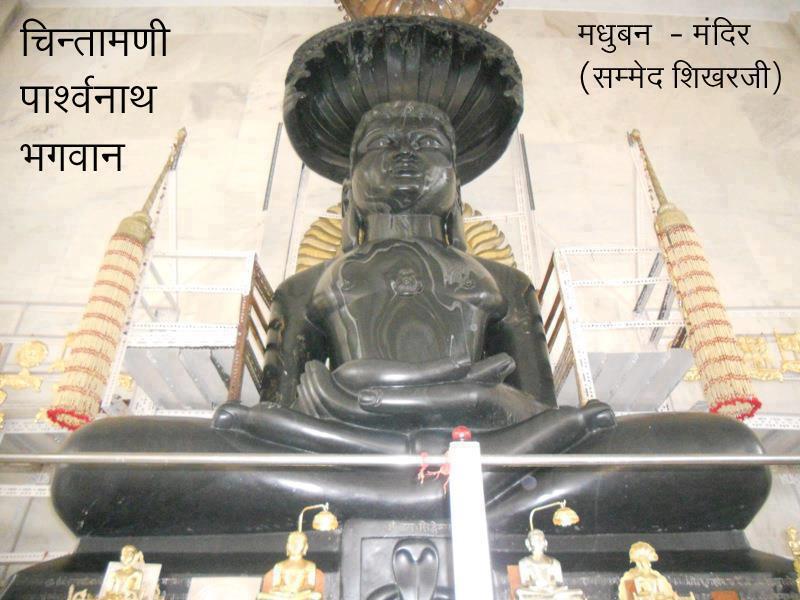
The Kalyan Mandir Stotra is dedicated to the twenty third Tīrthaṅkara, Lord Pārśvanātha, whose life and teachings emphasize compassion, restraint, and inner awakening.
Conclusion
Together, the Bhaktamara Stotra and the Kalyan Mandir Stotra form a spiritual pair. One is not complete without the other. Both teach that devotion is not about seeking favors, but about becoming worthy of liberation through inner transformation.
They remind the devotee that the true miracle is not the breaking of locks or the splitting of stone, but the quiet dissolution of Karma and the awakening of the soul.
Table of Comparison
| Aspect | Bhaktamara Stotra | Kalyan Mandir Stotra |
|---|---|---|
| Composer | Ācārya Mānatunga | Ācārya Kumudacandra |
| Presiding Tīrthaṅkara | Lord Ādinātha (Rishabhadeva) | Lord Pārśvanātha |
| Traditional Context | Composed during imprisonment under royal authority | Composed in a royal court in response to a philosophical challenge |
| Miraculous Association | Breaking of forty eight locks during recitation | Revelation of Lord Pārśvanātha from a Shiva Linga |
| Primary Purpose | Devotional praise leading to inner strength and liberation | Devotional praise leading to purification and liberation |
| Worldly Benefits | Removal of fear, illness, imprisonment, obstacles | Removal of calamities, fear, karmic bondage |
| Ultimate Goal | Destruction of Karma and attainment of Moksha | Destruction of Karma and attainment of Moksha |
| Concept of Grace | Grace arises through purification of the devotee’s thoughts | Grace arises through purification of the devotee’s thoughts |
| View of the Lord | Vitaraga, passionless, non intervening | Vitaraga, passionless, non intervening |
| Role of Devotion | Generates shubha parinama in the devotee | Generates shubha parinama in the devotee |
| Description of Pratiharyas | Described in a dedicated sequence of verses | Described in a dedicated sequence of verses |
| Number of Pratiharyas | Eight (Aṣṭa Prātihārya) | Eight (Aṣṭa Prātihārya) |
| Tone of the Poet | Deep humility and surrender | Deep humility and surrender |
| Opening Mood | Apology for inability to praise infinite virtues | Apology for inability to praise infinite virtues |
| Philosophical Emphasis | Power of devotion and non violence | Power of inner transformation and detachment |
| Sectarian Acceptance | Revered by Digambara and Śvetāmbara traditions | Revered by Digambara and Śvetāmbara traditions |
| Use in Practice | Daily recitation, fear removal, spiritual strength | Daily recitation, inner purification, meditation |
| Literary Status | Pinnacle of Jain stotra literature | Pinnacle of Jain stotra literature |