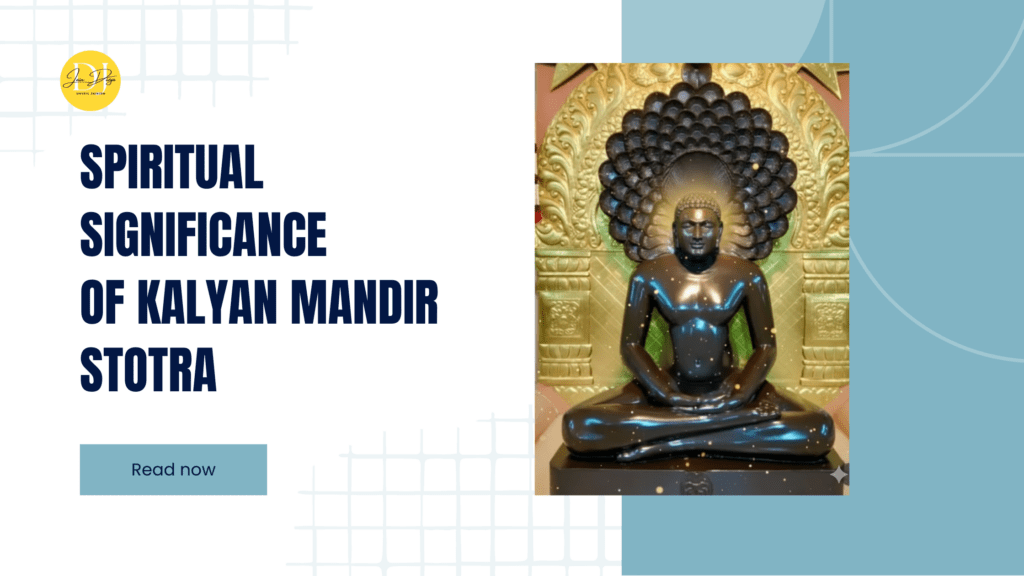
The Kalyan Mandir Stotra is far more than a hymn of praise. It is a deeply transformative spiritual text. Composed by Ācārya Kumudacandra in devotion to Lord Pārśvanātha, this stotra functions as a guiding path for the soul. Its true purpose is to help the devotee cross the vast ocean of Samsara and gradually align the self with the state of the Divine.
Rather than offering miracles or external rewards, the stotra works inwardly. It reshapes the devotee’s consciousness, purifies inner intentions, and leads the soul toward liberation.
Below are the key dimensions of its spiritual depth.
1. Transformation of the Self into the Divine
The most profound message of the Kalyan Mandir Stotra is the possibility of attaining the state of the Supreme Soul, known as Paramatma dasha.
In verse 15, the poet uses the powerful image of gold. Just as raw stone is transformed into gold through intense fire, an ordinary soul is transformed into the Supreme Soul through deep meditation on the Jina. The change is not symbolic but essential. The nature of the soul itself is refined.
Verse 17 takes this idea even further. It explains that when wise seekers meditate on their own soul as non distinct from the Lord, their soul begins to reflect the Lord’s power. The verse compares this to water becoming nectar when infused with the belief that it is nectar. The transformation occurs through inner conviction and awareness.
2. Understanding Grace in Jain Philosophy
The stotra clarifies an important Jain principle. Liberation does not come from a God who grants favors or intervenes in human affairs. Instead, transformation arises within the devotee.
Verse 29 presents a beautiful paradox. The Jina is described as indifferent to the ocean of birth, completely detached from worldly existence. Yet He still enables souls to cross it. This happens not because the Lord acts, but because the devotee chooses to cling to His path and ideals. Salvation arises from inner alignment, not divine intervention.
The Vitaraga Lord is untouched by praise or blame. However, when a devotee remembers His pure qualities, it creates auspicious inner states known as shubha parinama. These positive inner movements attract merit and dissolve sin. The change happens entirely within the devotee’s own consciousness.
3. Destruction of Karma
One of the most powerful roles of the Kalyan Mandir Stotra is its ability to weaken karmic bondage.
Verse 8 offers a striking metaphor. Snakes tightly coiled around a sandalwood tree loosen their grip the moment a peacock approaches. In the same way, when the Lord resides in the devotee’s heart, even deeply rooted karmic bonds begin to loosen immediately.
Verse 13 highlights another subtle truth. The Lord destroys the thieves of Karma not through anger, but through peace. Just as frost, though cold, can burn and destroy a forest, inner stillness and non violence are capable of dissolving even the strongest karmic forces.
4. Freedom from Passion and Attachment
The stotra repeatedly emphasizes the state of Vitaraga, freedom from passion.
Verse 24 uses the Ashoka tree as a metaphor. Near the Passionless One, even the natural redness of the Ashoka tree disappears. Symbolically, this means that any living being who comes into the presence of the Lord naturally begins to shed attachment and desire. Passion does not survive near pure detachment.
This teaching reminds the devotee that spiritual purity is contagious. Proximity to higher consciousness transforms the lower.
5. The Importance of Inner Feeling
The stotra strongly warns against mechanical devotion.
Verse 38 makes a clear statement. Even if one hears about the Lord, worships Him, or sees Him, it is of no value if the Lord is not held in the heart with true devotion. Actions performed without inner feeling or Bhava produce no spiritual result.
This verse shifts the focus from ritual to sincerity. What matters is not how much one does, but how deeply one feels.
6. The Ultimate Goal: Liberation
Although the Kalyan Mandir Stotra is often associated with protection and well being, its final aim is liberation.
Verse 44 concludes the hymn with clarity. Devotees may experience heavenly pleasures as a result of their devotion, but these are not the end. Eventually, through continued purity and awareness, they destroy all accumulated Karma and attain Moksha.
The devotee’s prayer is not limited to safety or success. It seeks Bodhi labha, the awakening of right knowledge, and Samadhi marana, a peaceful and conscious death that leads toward liberation.
Conclusion
The Kalyan Mandir Stotra truly lives up to its name, a Temple of Welfare. It acts as a ship for souls drowning in the ocean of existence. Through devotion, reflection, and inner transformation, the stotra aligns the devotee’s soul with the qualities of the Omniscient Lord Pārśvanātha.
It does not promise miracles. It promises something greater: inner change, freedom from bondage, and the quiet but certain journey toward Moksha.