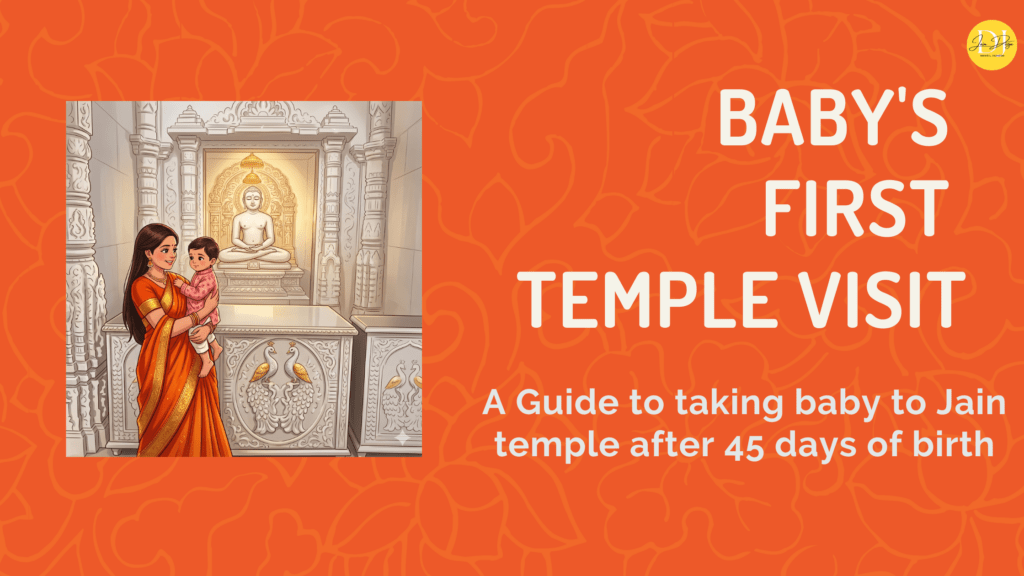
The moment your 45-day-old child first enters the temple is not just a family occasion. It is a sacred spiritual milestone that shapes their soul’s journey for lifetimes to come.
What Is the Pratham Jin Darshan Vidhi?
In Jain Garbh Sanskar, the journey of spiritual nurturing begins in the womb. The first major milestone outside the home, however, arrives 45 days after birth. This is the Pratham Jin Darshan Vidhi — your baby’s first formal introduction to the divine frequency of Jinendra’s presence in the temple.
This is not simply “taking the baby to the mandir.” It is a structured, mantra-backed ceremony that creates a spiritual protective shield around your child’s consciousness from the very beginning of their worldly life. Through sacred sounds, symbolic markings, and heartfelt prayers, this vidhi plants seeds of Samyak Gyaan (Right Knowledge) deep into the infant’s subconscious mind.
If you have been following Jain Garbh Sanskar practices during pregnancy, consider this the ceremony that brings all of that inner preparation into the sacred social space of the temple, anchoring your child’s soul in the shelter of Dev, Shastra, and Guru.
Why the 45th Day?
The 45-day period marks the transition from the secluded home environment, where mother and child recover and bond, to the larger world. Spiritually, it symbolises the soul’s emergence into its new dignified life, ready now to receive the blessings of the Tirthankaras. Choosing this moment for the first darshan ensures that the very first worldly impression upon the child is one of divine frequency.
The Significance of Samskaras — Why This Ceremony Matters
Before we walk through the ritual steps, the original scripture offers these opening words on why Samskaras exist at all:
ॐकारं बिंदु संयुक्तं नित्यं ध्यायंति योगिनः | कामदं मोक्षदं चैव ॐकाराय नमो नमः ||
श्री वर्धमान अरहंतमनन्तशक्तिं |आनंद कंदमभिनय जगत् प्रकाशम् ||धर्म प्रकाशन कृते ध्रियतेऽस्य सावैः |संस्कार पावन विधि पूर्वविधि वर्धनोक्तः ||संस्कारतो भवति मानव विशुद्धा |संस्कारतो भवति सर्व मनीषितं इदम् ||
The meaning is profound: it is through Samskaras that a human being is purified. It is through Samskaras that every cherished aspiration of life becomes attainable. Every step in this vidhi is not tradition for tradition’s sake. It is a conscious act of purification and elevation for a new soul.
What You Will Need: The Complete Samagri List
Before the ceremony, gather the following items:
Plates and Vessels
- 2 large plates (Thali)
- 2 water pots (Kalash)
- 2 spoons
- 2 bowls
- 1 small plate
Ritual Items
- Kalanwa (sacred thread)
- Yellow mustard seeds (Peeli Sarson)
- Sandalwood paste in a bowl
Offerings
- Ashta Dravya (the eight sacred substances used in Jain puja)
- 1 Shwet Shriphal (white coconut)
Sacred Items
- Gandhodak (consecrated water collected during the idol’s Abhishek)
- Siddha Yantra or Vinayak Yantra (for home ceremonies)
- A copy of the Shastra (scriptures)
Seating
- 2 wooden stools (Kashtasan or Paata)
- ₹11 to be placed beneath the stool
Clothing
- Father: Dhoti and dupatta
- Mother: Saffron (Kesariya) saree
Preparation for the Visit
On the 45th day, the mother and child bathe and wear pure, new clothes. The family then proceeds to the temple, ideally in a celebratory procession accompanied by music, because this is not a solemn occasion. It is a joyful one. The soul of your child is being formally introduced to their spiritual home.
Upon arrival, the father performs the Abhishek of the Jinendra idol and carefully collects the sacred Gandhodak. This consecrated water will be used directly on the child in the steps that follow.
Setting the Sacred Space
Before the ceremony begins, a beautiful foundation is prepared:
- Create an eight-petaled lotus (Ashta-pankhudi) rangoli on the ground using Roli or coloured powder.
- Place a wooden stool over the rangoli with ₹11 beneath it.
- The mother sits on the stool for a girl child, or the father for a boy child, with the baby held in their lap. If a learned sister is conducting the ceremony, the mother is seated regardless of the child’s gender.
Each petal of the eight-petaled lotus represents one of the eight karmas, the layers that bind the soul. Sitting upon this symbol means the child’s life journey is spiritually supported by the highest goal: the destruction of all karmas and ultimate liberation (Moksha).
The Step-by-Step Ceremony
Step 1: Mangalacharana — Opening Invocations
The ceremony opens with the Mangalashtak or Navdev Stuti, purifying the environment and invoking the energy of the Panch Parameshthi (Five Supreme Beings) as witnesses and protectors:
अर्हन्तो भगवत इन्द्रमहिताः सिद्धाश्च सिद्धीश्वराः, आचार्या जिनशासनोन्नतिकराः पूज्या उपाध्यायकाः। श्रीसिद्धांतसुपाठका मुनिवरा रत्नत्रयाराधकाः, पञ्चैते परमेष्ठिनः प्रतिदिनं कुर्वन्तु नो मङ्गलम्॥
This step invites the highest spiritual energies to be present and to act as witnesses throughout the entire vidhi.
Step 2: The Tilak Ceremony
The family is offered the auspicious tilak of sandalwood paste. While reciting the mangal verse, the tilak is applied to all present:
मंगलं भगवान वीरो, मंगलं गौतमो गणी | मंगलं कुंद कुन्दाद्यो, जैन धर्मोस्तु मंगलं ||
Then, while applying the tilak specifically on the child’s forehead, this tilak mantra is recited:
ॐ ह्रीं अहं अ सि आ उ सा नमः तव भाल स्थले सर्व सुख शान्त्यर्थं तिलकं करोमि
The significance of the chandan tilak carries a beautiful life lesson. Sandalwood, even when ground again and again, never loses its fragrance. In the same way, may this child face the hardships of life but never abandon Sanyam (self-restraint). This is the first lesson silently inscribed on the child’s forehead.
Step 3: The First Mantra in the Ear — Jin Darshan Mantra
Before the Gandhodak is applied, a Jain scholar, a Tyagi, or a learned elder whispers this mantra into the child’s right ear:
ॐ नमोऽर्हते भगवत जिन भास्कराय जिनेन्द्र प्रतिमा दर्शने अस्य बालकस्य दीर्घायुष्यं आत्मदर्शनं च भूयात्
“O Lord, the Sun of the Jinas! May this child, upon beholding the image of the Jinendra, attain long life and the vision of the Self.”
This is the very first mantra your child receives in this world. It is not a prayer for worldly success. It is a prayer for the highest gift of all: the realisation of the Self (Atma Darshan).
Step 4: Amrut Snaan — The Nectar Bath
The sacred Gandhodak is then applied to the child’s forehead while the Amrut Mantra is recited. This is a prayer that the child remains forever untouched by spiritual ignorance, bathed instead in the nectar of Right Knowledge:
ॐ ह्रीं अमृते अच्युतोद्भवे अमृतं वर्षणे अमृत श्रावय २ सं सं क्लीं २ बलूं २ ह्रां २ ह्रीं २ ह्रावय २ ठाः २ ह्रीं नमः स्वाहा
This is not a physical bath. It is a spiritual anointing. The Gandhodak carries the vibrational imprint of the Tirthankar’s Abhishek, making it the most sacred water your child can be touched with at this stage of life.
Step 5: Sarson Prasepan — Directional Protection with Mustard Seeds
In one of the most visually striking parts of the ceremony, the parents throw yellow mustard seeds (Peeli Sarson) in each of the four cardinal directions and then universally, creating a 360-degree spiritual shield around the child. Each mantra invokes one of the Panch Parameshthi to remove Vighna (obstacles and negative energies) from that direction in the child’s future:
East (Purva):
ओम् ह्रां णमो अरिहंताणं ह्रां पूर्व दिशासु आगत विघ्नान निवारय-२ सर्वं रक्ष-२ स्वाहा ।
South (Dakshin):
ओम् हीं णमो सिद्धाणं ह्रीं दक्षिण दिशासु आगत विघ्नान निवारय-२ सर्वं रक्ष-२ स्वाहा ।
West (Paschim):
ओम् हूं णमो आइरियाणं हूं पश्चिम दिशासु आगत विघ्नान निवारय-२ सर्वं रक्ष-२ स्वाहा ।
North (Uttar):
ओम् ह्रों णमो उवज्झायाणम् ह्रों उत्तरदिशासु आगत विघ्नान निवारय-२ सर्वं रक्ष-२ स्वाहा ।
Universal (Sarva Disha):
ओम् ह्रः णमो लोएसव्वसाहूणं ह्रः सर्व दिशासु आगत विघ्नान निवारय-२ सर्वं रक्ष-२ स्वाहा ।
Step 6: Kayotsarga and Gratitude
The family stands in the meditative Kayotsarga posture. In this deeply centering stillness, they bring to mind the eternal Jin Shashan, the Tirthankaras, the Acharyas, and the Sages. Gratitude is expressed to the Jinvani (scriptures) and to all sacred temples across the three worlds, both man-made and naturally formed.
This step acknowledges the infinite spiritual lineage behind this child’s birth into a Jain family. It anchors the child’s soul in a wisdom tradition that stretches back to the very first Tirthankara.
Step 7: Wrist Protection — Tying the Kalawa
A formal bow is offered to Siddha Bhagwan. Then the sacred thread (Kalawa) is tied three times around the wrist. The right wrist for the child and father, and the left wrist for the mother.
While tying, recite:
ओम् नमो अर्हते सर्वम रक्ष-२ हक्ष-२ हूं फट स्वाहा ।
This thread is not merely decorative. It is a constant physical reminder of spiritual protection and the lifelong commitment to virtue.
Step 8: Sacred Markings on the Child’s Forehead
Using Gandhodak, write ॐ in the centre of the child’s forehead. Above the ॐ, add the following symbols:
- Three dots representing the Ratnatraya: Samyak Darshan (Right Faith), Samyak Gyaan (Right Knowledge), and Samyak Charitra (Right Conduct)
- A crescent moon with a dot representing the Siddhashila and the Siddha Parameshthi
- Eight surrounding dots representing the Ashta Mulgun, the Eight Primary Virtues
A Swastika is also drawn on the Shwet Shriphal (white coconut). Then yellow rice (pushp) is gently showered on the child’s head while this mantra is recited:
ओम् ह्रीं श्री अरहंत सिद्ध आचार्य उपाध्याय सर्व साधुभ्यो साक्षिभ्यो अष्ट मूल गुण प्रदायाय अर्घं निर्वपामीति स्वाहा ।
This shower of yellow rice (pushp) is a joyful offering, calling upon all five Parameshthi as witnesses to bestow the Eight Primary Virtues upon this new soul.
Step 9: Addressing the Child — Sowing Spiritual Seeds
This is the heart of the ceremony. The mother or a family elder speaks directly into the child’s ear. The infant may not understand the language, but they are extraordinarily sensitive to the emotional vibration of their mother’s voice and to the high-frequency sounds of the mantras. This is soul-to-soul communication.
The Awakening of the Soul (Atma-Bodh)
“O Grand Soul (Bhavya Atman)! In your beginningless wandering through the cycle of birth and death, you found no lasting peace. Now, through great fortune, you have gained the rare association of the detached (Vitragi) Lord, the Scriptures, and the Sages — the bestowers of the Three Jewels. Listen with a careful heart, remember them, and always remain under their protection.”
Defining the Life’s Purpose (Param-Hit)
Inspired by the life of Acharya Vishuddha Sagar Ji, the mother speaks:
“O Great Being! Today, for the first time, I speak to you of your highest good. Come daily to the feet of the Lord (Shri Ji). May your devotion remain fixed upon God, the Scriptures, and the Sages. Your merit (Punya) is powerful; may you find joy only in these sacred feet and aspire to dwell on the Siddhashila — the abode of liberated souls — so that you never wander through the four realms of suffering again.”
The Mother’s Entrustment to the Lord
Turning toward Jinendra Bhagwan, the mother then says:
“O Vitragi Lord! My child is now at Your feet. My child is in Your shelter. Please watch over and protect this soul!”
These words are not just blessings. They are a vow for the parents themselves — a reminder that their child is a Divine Trust, and their primary duty is to facilitate the child’s spiritual evolution above all worldly pursuits.
Step 10: The Parents’ Prayer — Mata-pita Ki Arthna
After addressing the child, the parents turn to the Lord one final time and offer this devotional prayer. These verses capture the deepest longing of every Jain parent’s heart:
हे वीरा प्रभु महान ! तेरे चरणों में है मेरा लाल, तेरे शरण में है मेरा लाल |
तूं रखना इसे संभाल, तेरे चरणों में है मेरा लाल, तेरे शरण में है मेरा लाल ||
कठिन कठिन संसार का मारग, कोमल इसके प्राण |
इस भवसागर के दुखों से, कौन दिलावे त्राण ? प्रभुजी कौन दिलावे त्राण ??
हे रत्नत्रय दातार ! ये ओढ़े संवर ढाल | तेरे चरणों में है मेरा लाल…
इन्द्रिय विषयों के खातिर, यह जीवन नहीं गवावे |
संयम धारण करके प्रभुजी ! कभी न चित भरमावे |
तेरे ज्ञान की लिये मशाल, सदा हो उन्नत इसका भाल | तेरे चरणों में है मेरा लाल…
मुनि मारग को पाकर प्रभुजी ! नहीं शिथिलता लावे |
निजातम में रमके प्रभुजी ! केवल ज्ञान सु पावे |
जवन सफल बनाके प्रभुजी ! अरहंत कहावे लाल | तेरे चरणों में है मेरा लाल…
आतम हित के मारग में, यह आगे बढ़ता जावे |
शिवमहल में जाकर वीरा, लौट कभी न आये |
हे शिवरमणी भर्तार ! यों जीते काल कराल | तेरे चरणों में है मेरा लाल…
Read these verses slowly and let them settle in your heart. No parent who recites these words before the Lord can remain merely a parent of the body. These verses transform a mother into a spiritual guide.
Step 11: Sound Sanskar — Namokar Mantra and Chattari Dandak
A Jain scholar, a celibate practitioner (Tyagi), or a celibate sister now whispers the Namokar Mantra and the Chattari Dandak into the child’s right ear, then the left.
These divine sounds purify the child’s auditory senses and plant the first seeds of Right Knowledge within the subconscious mind. For the infant, this may be the very first experience of mantra. Research on infant development confirms that newborns are deeply attuned to sound and to the emotional tone of familiar voices at this stage of life.
For children 8 years and above: guide them to recite these mantras aloud with pure pronunciation and then make a formal offering (Arghya) of yellow rice (pushp) or flowers at the altar themselves.
Step 12: The Full Aashirwad Mantra
With yellow rice (pushp) being slowly showered on the child’s head, the complete Aashirwad mantra is now recited. This blessing covers every dimension of the child’s life — long life, good character, wisdom, health, and ultimately liberation:
दीर्घायुस्तु शुभमस्तु सुकीर्तिरस्तु | सद्बुद्धि रस्तु धन धान्य समृद्धि रस्तु || आरोग्य मस्तु विजयोऽस्तु पुण्य कल्याण मस्तु त्व सिद्ध पति प्रसादात् ||
पापानि शायन्तु, घोरानि शायन्तु, प्रतिकूलानि शायन्तु | पुण्यं वर्धतां, धर्मो वर्धतां, सौख्यं वर्धतां, अभयं वर्धतां | श्री वर्धतां, आरोग्यं वर्धतां, वर्धतां वर्धतां वर्धतां | स्वस्ति भद्रं चास्तु श्री मल्लिनेन्द्र चर्नाब्जवन्दे भक्तिः सदास्तु ||
Then, continuing to shower yellow rice (pushp), recite:
“May the command of the auspicious and supreme Jin-Shashan always stay upon your forehead. May all be auspicious — कल्याणमस्तु.”
The child is then blessed to attain the greatest spiritual milestones of life:
| Blessing | Meaning |
|---|---|
| उपनयन निष्क्रांतभागीभव | May you attain the milestone of sacred initiation |
| विवाह निष्क्रांतभागीभव | May you enter the householder’s path with righteousness |
| मुनीन्द्र निष्क्रांतभागीभव | May you attain the status of a great Sage |
| मंदराभिषेक निष्क्रांतभागीभव | May you receive the celestial Abhishek of Indra |
| यौवराज्य निष्क्रांतभागीभव | May you attain spiritual sovereignty |
| महाराज्य निष्क्रांतभागीभव | May you attain the great spiritual kingdom |
| परमराज्य निष्क्रांतभागीभव | May you attain the supreme spiritual realm |
| आर्हत्य निष्क्रांतभागीभव | May you attain the status of an Arhant, a Supreme Soul |
Step 13: The Namkaran — Blessing in the Child’s Name
At this point in the ceremony, the child’s name is formally spoken before the assembly and before the Lord. The following blessings are recited using the child’s given name:
अष्ट सहस्र नाम भागी भव | विजय नामाष्ट सहस्र भागी भव | परम नामाष्टी सहस्र भागी भव | (बालक का नाम लेकर) कल्याण मस्तु भव | तव सिद्धपति प्रसादात् |
This sub-ceremony ensures that the child’s very name is consecrated in the presence of the Panch Parameshthi, connecting their earthly identity to their highest spiritual potential from the very first day.
Step 14: Shantipaath — Closing the Ceremony
The ceremony concludes with the recitation of the Shantipath (Prayer for Universal Peace). The family then stands in a final Kayotsarga posture to express gratitude to the Lord for the successful completion of the ritual.
The Visarjan prayer is then recited to formally conclude the invocation.
As a closing gesture, the family expresses the intention to give the four types of charity — Aahar Daan (food), Aushadhi Daan (medicine), Shastra Daan (scriptures), and Abhaya Daan (protection from fear) — and seeks the blessings of all monks, elders, and Tyagis present.
Saavadhani — Important Guidelines for Parents
The original scripture lists practical guidelines that every family must follow after the ceremony. They are not formalities. They are the continuation of the vidhi into everyday life.
During the ceremony itself: Do not give mantras to a child who is crying or sleeping. Wait until the child is calm and fully receptive.
Until the child turns 8 years old: The mother and father are responsible for maintaining the child’s religious observances. The goal is that by age 8, the child is capable of maintaining them independently.
After age 8, introduce the child to:
- Ashta Mulgun (Eight Primary Virtues)
- Panchanuvratas (Five Minor Vows)
- Jin Darshan (daily temple visit)
- Drinking filtered water (Chhana Jal)
- Abstaining from eating after sunset (Ratri Bhojan Tyag)
From the very first day: Every morning when the child wakes and every night before they sleep, say OM nine times. Encourage the child to repeat it as well. The first word of their education should be OM.
For regular life: As soon as the child is old enough to understand, take them regularly to the Jin Mandir, Pathshala, and spiritual discourses (Pravachan). Visit all the Jinalays in your city. Let the temple become as natural and familiar to them as their own home.
At the ceremony, make it memorable: Take photographs of the tilak being applied, and of grandparents giving blessings. Gift the child something meaningful — a scripture, or a religious book. These become sacred memories that anchor the child’s identity as a Jain throughout their life.
In the years ahead: On the child’s birthday, organise a Vidhan, Pravachan, or spiritual camp. Involve the child in helping the poor and the sick through their own hands. Protect the child from excessive screen time and fill their environment with dharmic influence.
At age 14, introduce them to texts like Sushila Upanyas and Sheel Manjusha.
Never quarrel in front of the child, and never speak ill of others in their presence. You may, however, speak clearly about the five sins (Panch Pap) so they learn to recognise and avoid them.
Ensure the child has access to religious education, either at home or at the mandir. Sing or play religious lullabies (dharmic lorriyaan) from a young age — music is among the most powerful carriers of spiritual imprint in early childhood.
The Spiritual Blueprint — What This Ceremony Really Does
Think of a newly planted sapling in a dense jungle. Storms, parasites, and wild overgrowth can destroy it before it ever has a chance to become a great tree. To protect it, we build a strong fence and give it the right soil.
The Pratham Jin Darshan Vidhi is that spiritual fence. The mantras create a vibrational shield. The symbols imprint the highest truths on the child’s consciousness. The mother’s words sow the seeds of purpose. The blessings of the Panch Parameshthi give the sapling the best possible soil to grow toward the light of liberation.
This ceremony, like all Jain Garbh Sanskar kriyas, is ultimately not about ritual alone. It is about the kind of soul you are consciously choosing to raise.
A Note for Parents Doing This for the First Time
If you are new to Jain Garbh Sanskar and are performing this vidhi for the first time, here are a few gentle reminders:
Do not rush. Each step carries meaning. Take your time, especially during Step 9 (addressing the child) and Step 10 (the mother’s prayer).
The mother’s emotional state matters. Speak those words to your child with full feeling and presence. That vibration is the real transmission, not just the words themselves.
Involve a knowledgeable person. Have a learned Jain elder, a Tyagi, or an Acharya present to guide the recitation of the mantras for the first time.
Make it a family memory. This is the beginning of your family’s daily temple routine. The vidhi sets the intention and the daily practice fulfils it.
Begin OM from day one. Nine repetitions every morning and every night. It takes thirty seconds and it rewires a life.
This post is part of our ongoing Jain Garbh Sanskar series, covering Garbhanvaya Kriyas from the pre-conception rituals to the sacred samskaras of childhood. Save this guide, share it with new Jain parents, and may your child be blessed with the highest spiritual fortune.
Reference: Lekh from Br. Shri Sumat Prakash Ji