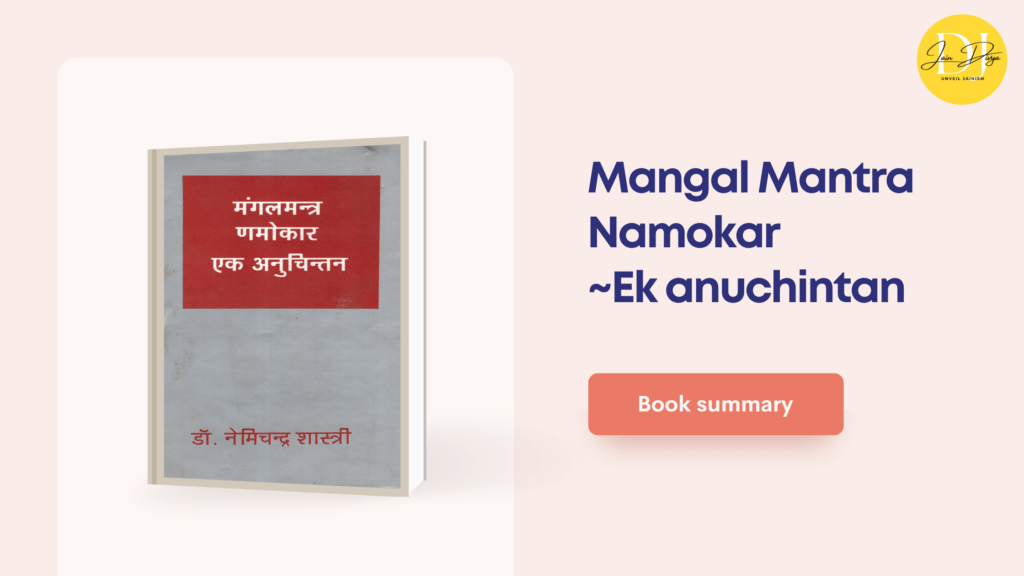
Dr. Nemichandra Shastri (Jyotishacharya) wrote “Mangal-Mantra Namokar: Ek Anuchintan”, a research-based treatise on Jainism’s most revered mantra. Published by Bharatiya Jnanpith, this work is a comprehensive guide that bridges the gap between ancient spiritual wisdom and modern analytical perspectives, with sections on astrology, psychology, and mathematics.
The Essence of the Namokar Mantra
The book describes the Namokar Mantra as a “Mangal” (auspicious) prayer that is eternal (Anadi-Nidhan) and not dependent on a specific creator. It is described as the essence of the entire Dvadashanga (the twelve sections of Jaina scriptures). According to the author, the mantra’s sounds generate both positive and negative electrical forces with the power to destroy sins and obstacles.
A Detailed Study of the Panch-Parmeshthi
A significant portion of the book is dedicated to explaining the five supreme beings saluted in the mantra:
- Namo Arihantanam: Salutations to the destroyers of inner enemies (vices like anger and greed).
- Namo Siddhanam: Salutations to the liberated souls who have achieved their final spiritual goal.
- Namo Aayariyanam: Salutations to the spiritual leaders who embody and teach the five-fold conduct.
- Namo Uvajjhayanam: Salutations to the teachers well-versed in the scriptures.
- Namo Loe Savva-Sahunam: Salutations to all practitioners globally who are on the path of self-realization.
The book also provides a unique justification for the order of the mantra, explaining why the Arihants (still in physical form) are saluted before the Siddhas (bodiless liberated souls), citing their role as the ultimate benefactors who reveal the path to liberation.
Methodology and the Eight Purifications (Ashta-Shuddhi)
Dr. Shastri emphasises that the success of the mantra is not accidental but depends on the prescribed methodology (Vidhi). The practitioner must adhere to eight types of purity:
- Dravya-shuddhi: Inner purity and compassion.
- Kshetra-shuddhi: A quiet, clean environment.
- Samay-shuddhi: Proper timing (dawn, noon, or sunset).
- Aasan-shuddhi: Stable posture (like Padmasan).
- Vinay-shuddhi: Devotion and respect.
- Man-shuddhi: Mental focus.
- Vachan-shuddhi: Accurate pronunciation.
- Kaya-shuddhi: Physical cleanliness.
The author highlights Maanas Jaap (mental chanting) as the most powerful form of recitation, stating it is a thousand times more effective than audible chanting.
1. Philosophical Justification of the Mantra’s Order
A unique aspect of the book is its deep dive into the “Pad-kram” (order of lines). Dr. Shastri addresses a common query: why the Arihants (who still have a physical body) are saluted before the Siddhas (the fully liberated, bodiless souls). The author cites Virasen Swami’s Dhavala Tika, explaining that the Arihants are our immediate benefactors (Upakari) who reveal the path to liberation; without them, the knowledge of the Siddhas would remain inaccessible.
2. The Science of Sound and “Matruka” Analysis
The sources reveal that the book contains a highly technical analysis of Mantrashastra (the science of sound energy).
- Matruka Sounds: The author explains that all the letters and sounds of the universe are contained within this “Maha-mantra”.
- Bija-Mantras: The book maps specific sounds to universal energies. For example, the sound ‘Aa’ is linked to the Saraswat-bija (wisdom), while ‘Eee’ is linked to Lakshmi-prapti (wealth).
- Energy Fields: Chanting produces both positive and negative electrical forces, which create a protective energy field or mandal around the practitioner.
3. Mathematical and Linguistic Foundations
The book includes a dedicated appendix on “Ganit-Sutra” (Mathematical Formulas) related to the mantra. It provides:
- A breakdown of the 35 letters and 5 lines (padas).
- Calculations involving vowels and consonants to derive spiritual meanings.
- The use of Prastar (permutation tables) to show how the 5 lines can be rearranged in 120 different ways, each offering a unique meditative focus.
4. Remedial and Therapeutic Applications
The book categorizes various “Prayogs” (applications) of the Namokar Mantra for overcoming worldly and physical obstacles. It lists specific mantras and methods for:
- Health: Remedies for fevers (Jwar-vinashak), headaches, and eye diseases.
- Protection: Guarding against fire (Agni-nivarak), poisons, and enemies.
- Success: Mantras for wealth (Lakshmi-prapti), royal/official favour, and general success in all tasks (Sarvakaryasadhak).
5. Transformation Through Narrative (Katha-Sahitya)
To illustrate the mantra’s power, the author includes an extensive collection of stories involving both humans and animals. Notable examples include:
- Animal Transformation: An ox who attained a higher birth after hearing the mantra.
- Moral Redemption: Stories of thieves, such as the one involving Anjan-chor, and individuals like Anantmati and Prabhavati, whose unwavering faith in the mantra saved them from extreme distress.
6. Psychological and Ethical Development
The book emphasizes the mantra’s role in mental purification (Man-shuddhi). By focusing on Panch-Parmeshthi virtues, the practitioner gradually replaces internal vices such as anger and pride with compassion and equanimity. The “sublimation” of basic instincts results in “Atma-kalyan” (spiritual well-being) and a transformed personality.
Source: Mangal-Mantra Namokar: Ek Anuchintan