I have been a vegetarian my entire life. I did not choose it one day after reading something or watching a documentary. I was born into it, and I understood why as I grew older. I cannot bear the smell of meat. I genuinely do not understand how someone can look at a living, breathing, feeling animal and decide that their taste preference is worth more than that animal’s life. Especially when every single nutritional need a human body has can be met without killing anything that breathes, feels pain, and wants to live.
This article is not an attack on anyone. But it is also not going to be gentle about the facts. Because the facts do not require gentleness. They require honesty.

This Is Not a Minor Dietary Preference
Let us start with where the meat prohibition sits in the Jain framework. Because many people, including many Jains, treat it as one rule among many. A lifestyle choice. A cultural habit.
Acharya Samantabhadra, in Verse 66 of Ratnakarand Shravakachar, is very clear about this:
मद्यमांसमधुत्यागैः सहाणुव्रतपञ्चकम्।
अष्टौ मूलगुणानाहुर्गृहिणां श्रमणोत्तमाः ।।66।।
Madyamāṃsamadhūtyāgaiḥ sahāṇuvratapañcakam,
aṣṭau mūlaguṇān āhur gṛhiṇāṃ śramaṇottamāḥ.
The great ascetics declare that the five Anuvratas, along with the renunciation of alcohol, meat, and honey, are the eight Mool Gunas of a householder.
The eight Mool Gunas are the most basic requirements of a Jain householder’s spiritual life. Not the advanced practices. Not the optional extras. The foundation. The very ground floor. Renouncing meat is one of these eight. It sits alongside the five Anuvratas that define the householder’s entire ethical life.
Then Verse 84 of the same text explains exactly why:
त्रसहतिपरिहरणार्थं क्षौद्रं पिशितं प्रमादपरिहृतये।
मद्यं च वर्जनीयं जिनचरणौ शरणमुपयातैः ।।84।।
Trasahatipariharaṇārthaṃ kṣaudraṃ piśitaṃ pramādaparihṛtaye,
madyaṃ ca varjanīyaṃ jinacaraṇau śaraṇamupayātaiḥ.
Those who have taken refuge at the feet of the Jina must renounce honey and meat to avoid the destruction of mobile beings, and must renounce alcohol to avoid carelessness and negligence.
Meat and honey are prohibited for the same specific reason. Tras Jeev Himsa. Violence against mobile beings who have multiple senses, who can feel pain, who experience fear, who want to live. This is the highest category of violence a householder is required to renounce. Not a side rule. The central one.
There Is No Such Thing as Meat Without Killing
Some people say they only eat meat from animals that were treated well. Or that died naturally. Or those that were killed humanely.
Acharya Amritchandra addresses this directly in Gatha 65 of Purusharthasiddhyupay:
न विना प्राणिविघातान्मांसस्योत्पत्तिरिष्यते यस्मात्।
मांसं भजतस्तस्मात् प्रसरत्यनिवारिता हिंसा ।।65।।
Na vinā prāṇivighātān māṃsasyotpattir iṣyate yasmāt,
māṃsaṃ bhajatas tasmāt prasaratyanivaritā hiṃsā.
Because meat cannot come into existence without the slaughter of living beings, unavoidable violence spreads for one who consumes it.
This is not a philosophical statement. It is a logical one. Meat is the flesh of a being that was alive. That being had to die for the meat to exist. There is no version of this transaction where the killing does not happen. The commentary on this verse puts it even more plainly:
“जीव का घात किये बिना माँस नहीं मिलता। इसलिए मांस खानेवाला हिंसा को कैसे नहीं करे? अवश्य करे ही करे।”
Meat cannot be obtained without killing a living being. How then can a meat-eater avoid violence? They cannot. They must commit it.
But what about meat from an animal that died naturally? Acharya Amritchandra closes this door too, in Gatha 66:
यद्यपि किल भवति मांसं स्वयमेव मृतस्य महिषवृषभादेः।
तत्रापि भवति हिंसा तदाश्रितनिगोतनिर्मथनात् ।।66।।
Yadyapi kila bhavati māṃsaṃ svayameva mṛtasya mahiṣavṛṣabhādeḥ,
tatrāpi bhavati hiṃsā tadāśritanigotanirmāthanāt.
Even meat from an animal that died naturally, like a buffalo or an ox, still causes violence. Because that meat becomes home to countless Nigod beings whose destruction occurs the moment it is consumed.
Every door is closed. Killed humanely. Died naturally. Does not matter. The moment flesh begins to decay, it becomes a field of new life. And consuming it destroys that life.
What Is Actually Inside That Piece of Meat
Acharya Kundakunda, in Pravachansar Gathas 32 and 33, describes what meat actually is at any given moment:
पक्केसु अ आमेसु अ विपच्चमाणासु मंसपेसीसु।
संतत्तियमुववादो तज्जादीणं णिगोदाणं ।।32।।
जो पक्कमपक्कं वा पेसीं मंसस्स खादि फासदि वा।
सो किल णिहणदि पिंडं जीवाणमणेगकोडीणं ।।33।।
Pakkesu a āmesu a vipaccamāṇāsu maṃsapesīsu,
saṃtattiyamuvavādo tajjādīṇaṃ ṇigodāṇaṃ.
Jo pakkamapakkaṃ vā pesīṃ maṃsassa khādi phāsadi vā,
so kila ṇihaṇadi piṃḍaṃ jīvāṇamaṇegakoḍīṇaṃ.
Whether raw, cooked, or being cooked right now on the fire, pieces of meat constantly generate Nigod beings of their own kind within them. Anyone who eats or even touches raw or cooked meat destroys a mass of countless crores of living beings.
The Ratnakarand Shravakachar commentary makes this even more direct:
“कच्चे मांस में, अग्नि से पकाये हुये मांस में, अग्नि पर रखे हुए बर्तन में पकते हुए मांस में भी अनन्त जीव निरन्तर उत्पन्न होते रहते हैं।”
In raw meat, in cooked meat, in meat being cooked on the fire at this very moment, infinite living beings are continuously being generated.
And Acharya Amritchandra adds in Gatha 68:
आमां वा पक्वां वा खादति यः स्पृशति वा पिशितपेशीम्।
स निहन्ति सततनिचितं पिण्डं बहुजीवकोटीनाम् ।।68।।
Āmāṃ vā pakvāṃ vā khādati yaḥ spṛśati vā piśitapeśīm,
sa nihanti satatanicītaṃ piṇḍaṃ bahujīvakoṭīnām.
One who eats or even touches a piece of meat, whether raw or cooked, destroys a mass filled with countless crores of living beings constantly accumulated within it.
Even touching it. That is how seriously the tradition treats this.
And Acharya Amitgati, in Verse 18/366 of his Shravakachar, describes what meat actually is in the most direct terms possible:
अत्ति यः कृमिकुलाकुलं पलं, पूयशोणितवसादिमिश्रितम्।
तस्य किञ्चन न सारमेयतः शुद्धबुद्धिभिरवेक्ष्यतेऽन्तरम् ।।18/366।।
Atti yaḥ kṛmikulākulaṃ palaṃ, pūyaśoṇitavasādimisritam,
tasya kiñcana na sārameyataḥ śuddhabuddhir avekṣyate’ntaram.
One who eats meat filled with swarms of worms and mixed with putrid blood and fat is seen by pure-minded people as no different from a dog.
That is not a polite description. It is not meant to be. It is meant to strip away the presentation, the seasoning, the restaurant plating, and show you what is actually on the plate.
It Is Not Just the Person Who Kills
Here is something most people have never considered. In the Jain framework, the sin of meat consumption does not belong only to the person who does the killing.
Acharya Amitgati, in Verse 17/365 of his Shravakachar, lists six types of people who share the karmic consequence:
हन्ति स्वादति पणायते पलं, मन्यते दिशति सन्स्करोति यः।
यान्ति ते षडपि दुर्गतिं स्फुटं, न स्थितिः खलु परत्र पापिनाम् ।।17/365।।
Hanti svādati paṇāyate palaṃ, manyate diśati saṃskaroti yaḥ,
yānti te ṣaḍ api durgatiṃ sphuṭaṃ, na sthitiḥ khalu paratra pāpinām.
Whoever kills, eats, sells, approves, prepares, or causes meat to be prepared. All six of these people clearly go to a state of suffering. There is no stable good future for such sinners.
Six people. The one who kills. The one who eats. The one who sells. The one who approves, meaning the person who says yes that sounds good, go ahead. The one who cooks it. And the one who causes it to be prepared, meaning the person who places the order.
Every person in that chain carries the weight of what happened to that animal. The distance between you and the killing does not reduce your participation in it.
Now Let Us Talk About Protein
This is the argument I hear most often. “I need protein. Plants do not give enough protein. Meat is the most efficient source of complete protein. What do you want me to do, be weak and deficient?”
Let me be straightforward about this.
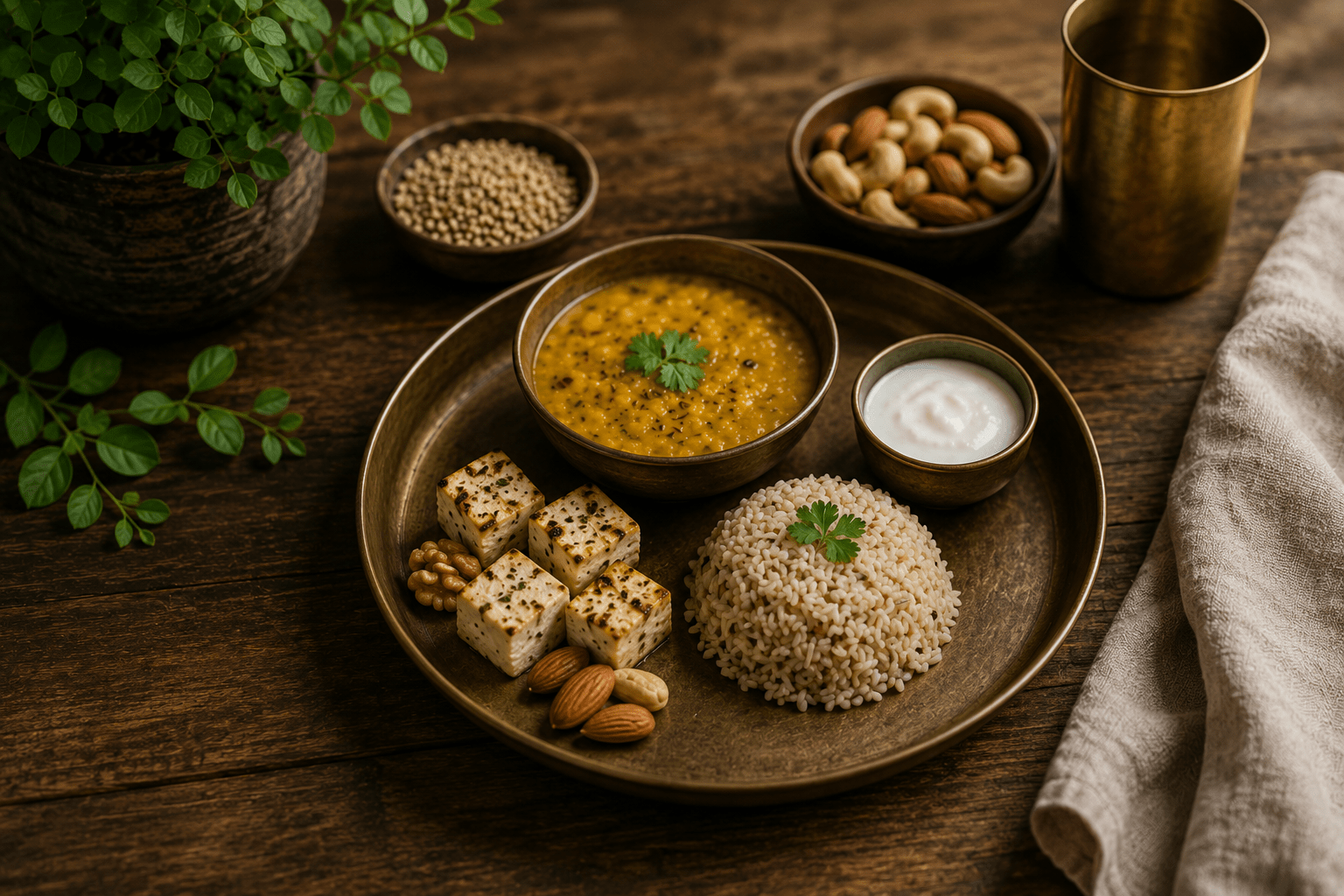
First, the factual claim. Lentils, chickpeas, rajma, tofu, paneer, dairy, nuts, seeds, quinoa, and dozens of other plant foods contain substantial protein. The idea that a vegetarian diet cannot meet protein needs is simply not true for anyone eating a reasonably varied diet. Millions of vegetarian athletes, bodybuilders, and ordinary healthy people around the world have demonstrated this for decades.
But let us set that aside. Let us say, for the sake of argument, that meat genuinely gave you more protein per gram than any plant source. Let us say it was the most efficient protein delivery system on the planet.
The question is still: is it worth it?
Acharya Amritchandra addresses this kind of efficiency argument directly in Gatha 82:
बहुसत्त्वघातजनितादशनाद्वरमेकसत्त्वघातोत्थम्।
इत्याकलय्य कार्यं न महासत्त्वस्य हिंसनं जातु ।।82।।
Bahusattvghātajanitādaśanād varam ekasattvghātottham,
ityākalayya kāryaṃ na mahāsattvasya hiṃsanaṃ jātu.
Thinking it is better to kill one large being than many small ones, one should never commit violence against a great five-sensed being.
This verse is directly addressing the efficiency logic. The argument that killing one cow gives you more nutrition per death than consuming hundreds of small organisms. Acharya Amritchandra does not accept this reasoning. He says explicitly: do not use this logic to justify killing a five-sensed being.
Why? Because violence is not measured by the number of deaths alone. It is measured by the level of consciousness destroyed. A five-sensed being, a cow, a goat, a chicken, a fish, possesses ten Pranas. Ten life forces. Five senses, mind, speech, body, breath, and lifespan. Destroying a being with ten Pranas causes a karmic burden that is incomparably greater than anything involved in consuming plant food.
The protein in that piece of meat comes at a cost that no gym result, no muscle gain, no athletic performance can justify. You are trading your soul’s progress for your body’s convenience.
And the scriptures also offer this perspective. Even a lion, whose entire biological nature is built around hunting and consuming meat, upon attaining Samyak Darshan, right understanding, abandoned meat entirely and found nourishment through other means. If even a naturally carnivorous being can find another way when its understanding is clear, the argument that humans have no choice becomes very difficult to make seriously.
What Meat Does to the Soul
Beyond the karmic mathematics, Acharya Amitgati makes a point in Verse 19/367 that is worth sitting with:
आमिषाशनपरस्य सर्वथा, विद्यते न करुणा शरीरिणः।
पापमर्जति तथा विना परं, बम्भ्रमीति भवसागरे ततः ।।19/367।।
Āmiṣāśanaparasya sarvathā, vidyate na karuṇā śarīriṇaḥ,
pāpamārjati tathā vinā paraṃ, bambhramīti bhavasāgare tataḥ.
A being engrossed in meat consumption has absolutely no compassion. Without compassion, they accumulate immense sin and wander endlessly in the ocean of worldly existence.
No compassion whatsoever. That is a strong statement. But think about what it means practically. The moment you decide that your protein goal matters more than the life of a being that can feel pain and fear death, you have made a choice about what you value. You have placed your body’s convenience above another being’s existence. That is not compassion. And the tradition says that without compassion, the soul cannot move forward. It only wanders.
Acharya Amitgati also says in Verse 25/373:
जीवों का मांस खाया हुआ, इस-लोक में और पर-लोक में दुःख-दायक होता है।
Eating the flesh of living beings causes suffering in this world and in the next.
This life and the next. The consequences are not only spiritual and future. They are present and material. A life built on the destruction of other lives does not produce peace. It produces a restlessness that no amount of protein can address.
And Acharya Jinsen, in Harivansh Puran Verse 69/102, captures the long-term spiritual picture:
कषायवशगः प्राणी हत्वा स्वस्य भवे भवे।
संसारवर्धनोऽन्येषां भवेदा वधको न वा ।।69/102।।
Kaṣāyavaśagaḥ prāṇī hatvā svasya bhave bhave,
saṃsāravardhano’nyeṣāṃ bhaved ā vadhako na vā.
A being driven by passions keeps killing life after life, increasing their own cycle of rebirth. Whether or not they are the killer of others, they are certainly the killers of their own spiritual progress.
The passion that drives meat consumption, the craving for a particular taste, a particular texture, a particular satisfaction, is Kashaya. And Kashaya binds the soul to Samsara. Every meal that comes from that craving, however nutritious it may be for the body, adds another chain to the soul.
The Question I Cannot Stop Asking
I have never been able to fully understand it. I know people who are kind, thoughtful, generous, and genuinely good. And they eat meat. And when I ask why, the most honest answer is usually: taste. Habit. It is just what I have always eaten.
Not survival. Not medically necessary. Not a situation where there is no other option. Taste and habit.
And on the other side of that taste is an animal that had a life. That felt warmth and fear and pain. That did not choose to be born into a world where its body was someone else’s meal.
The Jain tradition does not ask you to be perfect. It does not ask you to never make a mistake or to achieve zero harm in a single lifetime. But it does ask you to be honest. To look at what you are doing and ask whether it is worth what it costs.
You wanted protein. You can get protein from plants. The question was never really about protein.
The question is whether you are willing to pay attention to what your choices cost other beings. And whether you think the taste in your mouth for a few minutes is worth the life that ended so you could have it.
I am not angry asking this. I am genuinely asking. Because I do not have another way to understand it.

References:
- Purusharthasiddhyupay by Acharya Amritchandra, Gathas 65, 66, 68, 81, and 82.
- Ratnakarand Shravakachar by Acharya Samantabhadra, Verses 66 and 84.
- Pravachansar by Acharya Kundakunda, Gathas 32 and 33(Commentary by Acharya Jaysen).
- Amitgati Shravakachar by Acharya Amitgati, Verses 17/365, 18/366, 19/367, and 25/373.
- Harivansh Puran by Acharya Jinsen, Verse 69/102.