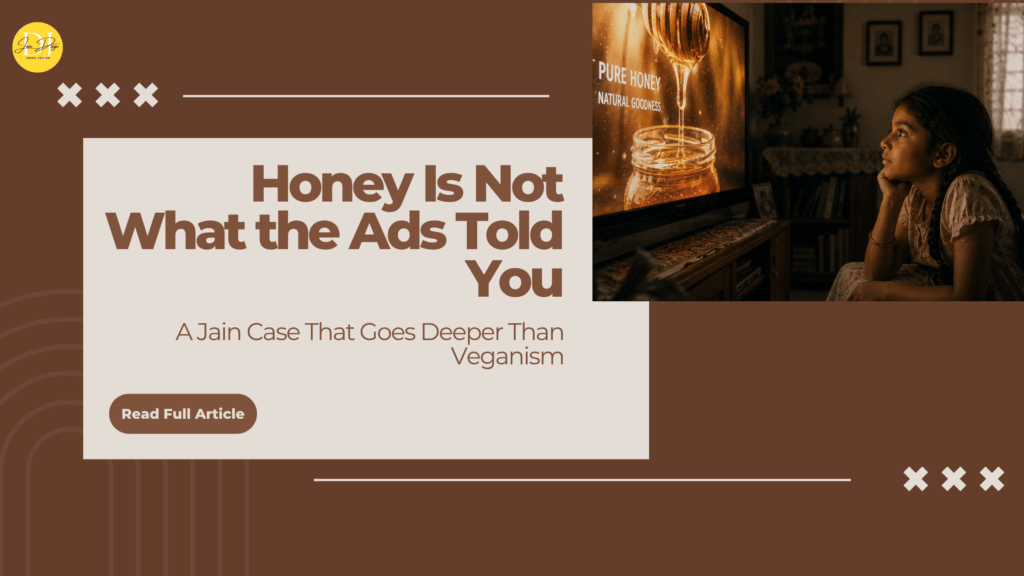
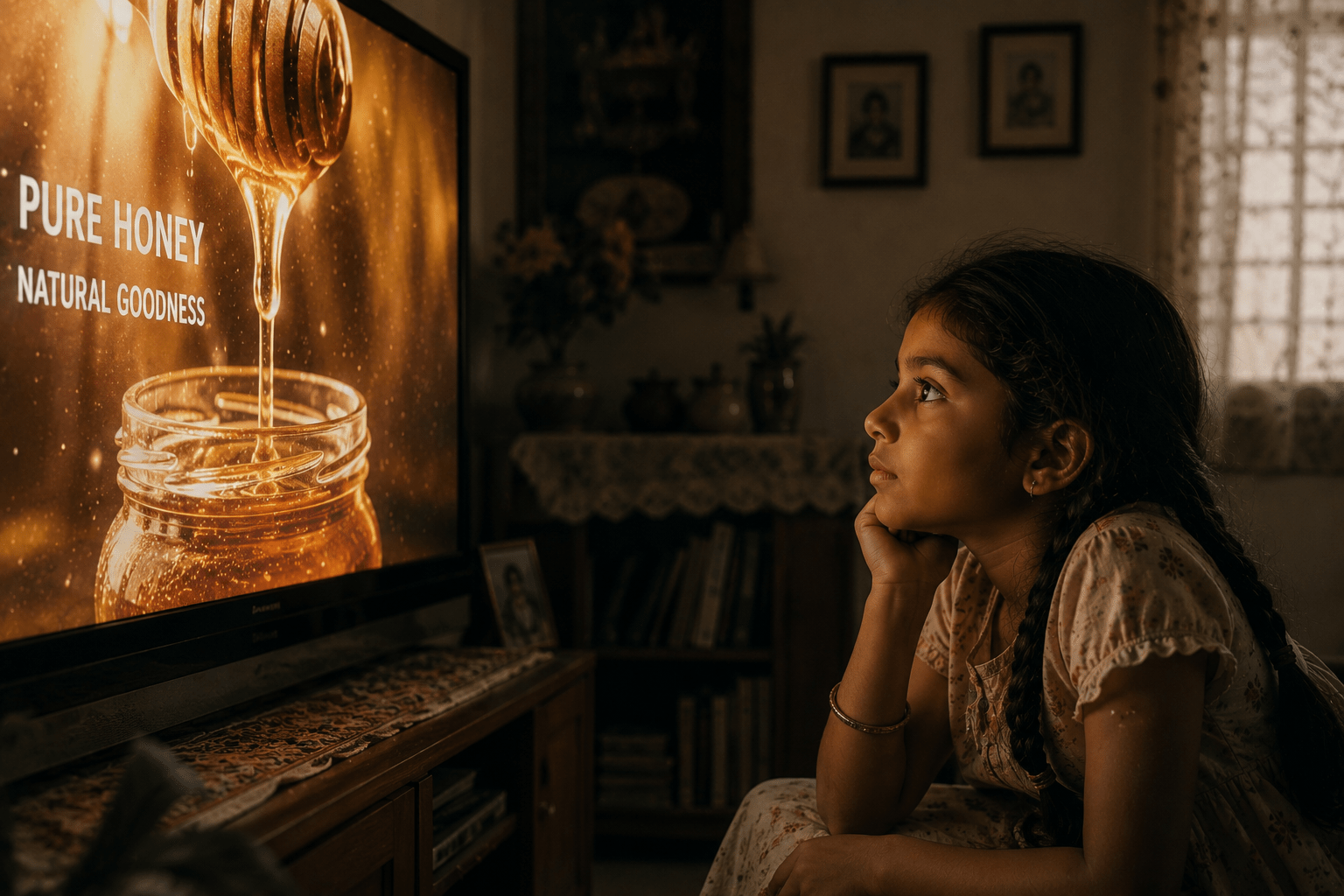
As a child, I loved honey advertisements. The golden colour. The slow drip from the spoon. The healthy, glowing people. Lemon and honey for immunity. Honey in warm water every morning. Every Ayurvedic medicine seemed to have honey in it.
I even tasted it once. Before I knew what I know now.
I am sharing this not to feel guilty about the past. I am sharing it because I think most people reading this are exactly where I was as a child. Honey feels innocent. It feels natural. It feels like the opposite of violence. The imagery around it has always been sunshine and flowers and something pure that nature made just for us.
Which is exactly why the Jain position on honey is so important to understand properly. Because it is not simply veganism taken one step further. It is not squeamishness about insects. It is a specific, carefully reasoned argument that, once you follow it honestly, is very hard to walk away from.
Today, I do not just avoid eating honey. I check labels on soaps, moisturisers, and cosmetics too. Not out of habit. Out of understanding.
This article is that understanding.
Why Honey Feels Different From Meat
Before we get into the argument, let us be honest about something. Most people, including many Jains, treat the honey prohibition as a minor rule. A good habit if you are serious. But not something as important as avoiding meat.
This is the first thing the scriptures ask you to question.
Because the texts do not treat honey as a minor matter at all.
Acharya Samantabhadra, in Verse 66 of Ratnakarand Shravakachar, writes:
मद्यमांसमधुत्यागैः सहाणुव्रतपञ्चकम् । अष्टौ मूलगुणानाहुर्गृहिणां श्रमणोत्तमाः ।।66।।
Madyamāṃsamadhūtyāgaiḥ sahāṇuvratapañcakam, aṣṭau mūlaguṇān āhur gṛhiṇāṃ śramaṇottamāḥ.
The great ascetics declare that the five Anuvratas along with the renunciation of alcohol, meat, and honey are the eight Mool Gunas of a householder.
The eight Mool Gunas are the most basic requirements of a Jain householder’s spiritual life. They are not advanced practices. They are not optional extras. They are the foundation. The ground floor. Without them, nothing else you build spiritually has anything solid to stand on.
Renouncing honey is one of these eight. It sits right alongside the five Anuvratas. That tells you exactly how the tradition weighs this.
Then in Verse 84, Acharya Samantabhadra explains the reason:
त्रसहतिपरिहरणार्थं क्षौद्रं पिशितं प्रमादपरिहृतये। मद्यं च वर्जनीयं जिनचरणौ शरणमुपयातैः ।।84।।
Trasahatipariharaṇārthaṃ kṣaudraṃ piśitaṃ pramādaparihṛtaye, madyaṃ ca varjanīyaṃ jinacaraṇau śaraṇamupayātaiḥ.
Those who have taken refuge at the feet of the Jina must renounce honey and meat to avoid the destruction of mobile beings, and must renounce alcohol to avoid carelessness and negligence.
Notice what this verse does. It gives a separate reason for each prohibition. Honey and meat are grouped together and prohibited for the same reason: Tras Jeev Himsa, violence against mobile beings who have multiple senses and can experience the world. Alcohol is prohibited for a different reason entirely, because it causes Pramada, spiritual carelessness.
Honey is not in a lighter category than meat. It is in the same category. Both involve the intentional destruction of multi-sensed mobile beings. That is the highest form of violence a householder is asked to renounce.
What Honey Actually Is: A Four-Sensed Being’s World
Most people think of honey as something bees make and leave in a comb. We collect it, they fly away, nobody is really hurt.
Acharya Kundakunda, in Gatha 116 of Panchastikaya, establishes what bees actually are in the Jain framework:
उद्दंसससयमक्खियमधुकरिभमरा पयंगमादीया। रूवं रसं च गंधं फासं पुण ते विजाणंति ।।116।।
Uddaṃsasayamakkhiya madhukari bhamarā payaṃgamādīyā, rūvaṃ rasaṃ ca gandhaṃ phāsaṃ puṇa te vijāṇanti.
Gnats, mosquitoes, flies, honeybees, bumblebees, and moths are four-sensed beings. They perceive form, taste, smell, and touch.
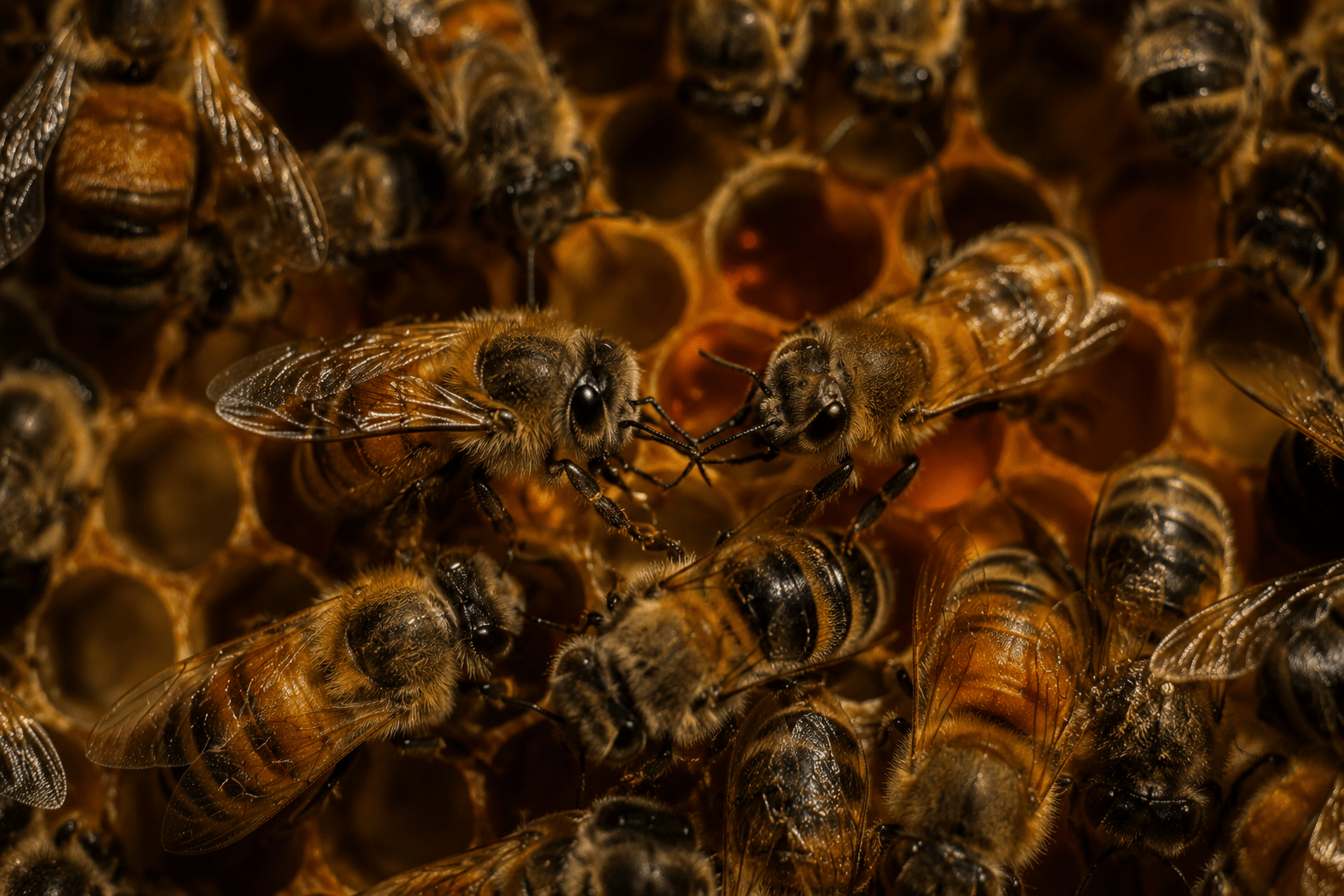
Honeybees have four senses. They are Tras Jeev, mobile beings, in the same broad category as animals and humans, just with fewer senses. They are not simple organisms. They can see, smell, taste, and feel. They experience the world. And what happens to them in honey production is not a minor footnote.
But the argument goes even deeper than the bees themselves.
Three Verses That Close Every Escape Route
Acharya Amritchandra, in Purusharthasiddhyupay, addresses honey across three consecutive Gathas. Each one closes a different argument you might want to make.
Gatha 69 closes the basic consumption argument.
मधुशकलमपि प्रायो मधुकरहिंसात्मकं भवति लोके। भजति मधु मूढधीको यः स भवति हिंसकोऽत्यन्तम् ।।69।।
Madhuśakalam api prāyo madhukara hiṃsātmakaṃ bhavati loke, bhajati madhu mūḍhadhīko yaḥ sa bhavati hiṃsako’tyantam.
Even a small piece of honey is generally the result of violence to honeybees. One who consumes it becomes an extreme doer of violence.
The word Acharya Amritchandra uses for such a person is Moodhadhi. Someone of dull understanding. He is not being harsh without reason. He is saying that consuming honey, when you know what it involves, is not a small innocent mistake. It is a choice made without thinking carefully about what you are actually doing.
Gatha 70 closes the ethical collection argument.
स्वयमेव विगलितं यो गृह्णीयाद्वा छलेन मधुगोलात्।
तत्रापि भवति हिंसा तदाश्रयप्राणिनां घातात् ।।70।।
Svayameva vigalitaṃ yo gṛhṇīyād vā chalena madhugolāt,
tatrāpi bhavati hiṃsā tadāśrayaprāṇināṃ ghātāt.
Even honey that drips naturally from a hive, or is collected carefully without directly harming bees, still involves violence. Because the beings that live within and around that honey are destroyed regardless.
Today many people say honey can be collected ethically. That careful beekeeping does not harm the bees. That this makes honey acceptable.
This verse answers that argument directly. The Jain objection is not about how honey is taken out of the hive. It is about what honey is. The violence identified here is not in the method of extraction. It is in the nature of honey itself, the living beings that exist within the substance at all times. Even honey that falls on its own, with no human involvement whatsoever, still hosts these beings. Taking it and consuming it is still Himsa.
Gatha 71 reveals the deepest argument of all.
मधु मद्यं नवनीतं पिशितं च महाविकृतयस्ताः।
वल्भ्यन्ते न व्रतिना तद्वर्णा जन्तवस्तत्र ।।71।।
Madhu madyaṃ navanītaṃ piśitaṃ ca mahāvikṛtayastāḥ,
valbhyante na vratinā tadvarnā jantavas tatra.
Honey, alcohol, fresh butter, and meat are great defilements. A person observing vows does not consume them because beings of the same colour as these substances live within them.
Tadvarna Jantavah. Beings of the same colour as the substance itself live inside it.
This is the line most people never hear. The prohibition on honey is not only about the bees in the hive. It is about the living beings inside honey itself. Beings too small to see. Beings that are destroyed the moment honey enters the body.
Honey is not a finished, lifeless product. It is a living substance that holds life within it from the moment it forms to the moment it is consumed. The golden colour you see in the jar, beings of that same colour live within it.
The Scale of the Sin
Acharya Amitgati, in his Shravakachar, makes a comparison that stops you completely. In Verse 27/375, he writes:
जो व्यक्ति अनेक प्रकार के जीवों के घात से उत्पन्न और महा दुःखों के देनेवाले मधु को खाते हैं; वे थोड़े जीवों के घातक खटीक के समान कैसे हो सकते हैं?
One who consumes honey, which is born from the destruction of many kinds of beings and causes great suffering, is considered an even greater sinner than one who kills animals for a living.
And then in Verse 28/376, he goes further:
ग्रामसप्तकविदाहरेपसा, तुल्यता न मधुभक्षिरेपसः।
तुल्यमञ्जलिजलेन कुत्रचिन्निम्नगापतिजलं न जायते।।28/376।।
The sin of burning seven villages cannot even be compared to the sin of consuming honey. Just as a handful of water cannot be compared to the water in an entire ocean.
Read that slowly. The burning of seven villages is less. The sin of consuming honey is more. Like a handful of water compared to an ocean.
This is not language designed to frighten. It is a language designed to break through the comfortable assumption that honey is a small thing. It is the tradition telling you, as directly as possible, that the scale of life destroyed in honey is far beyond what the eye can see or the mind easily imagines.

What About Using It as Medicine?
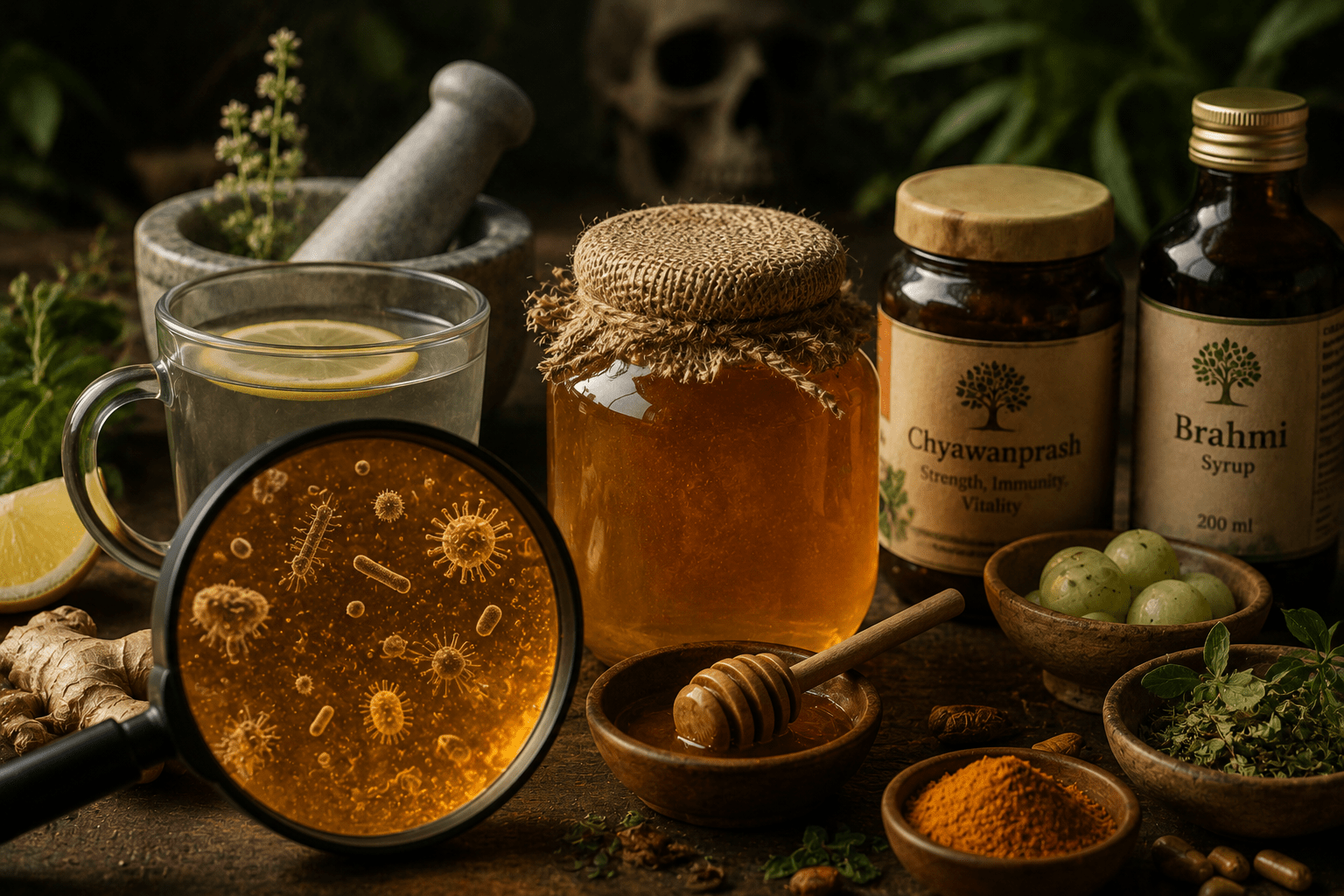
This is the last argument people reach for. If not for eating, then at least for health. For an Ayurvedic remedy. When a doctor recommends it.
Acharya Amitgati closes this door too, in Verse 32/380 of his Shravakachar:
यः भेषज-इच्छया नाम मधु अत्ति सः अपि लघु उल्वणं दुःखं याति।
One who consumes honey even with the intention of medicine still brings intense suffering upon themselves. Just as drinking poison hoping to extend your life only brings faster death, consuming honey for health still carries the full karmic weight of the violence involved.
And then from the commentary of Ratnakarand Shravakachar, one of the most striking lines in all of this material:
“मधु जैसी कोई अधम वस्तु नहीं है। मक्खियों का वमन।”
There is no substance as base as honey. It is the vomit of flies.
This is not poetic language used for dramatic effect. It is the tradition asking you to see honey for what it actually is before deciding what your relationship with it should be. The golden imagery of the advertisement is one way of seeing it. This is another. Both are describing the same substance.
Arambhi vs. Sankalpi Himsa: The Element of Choice
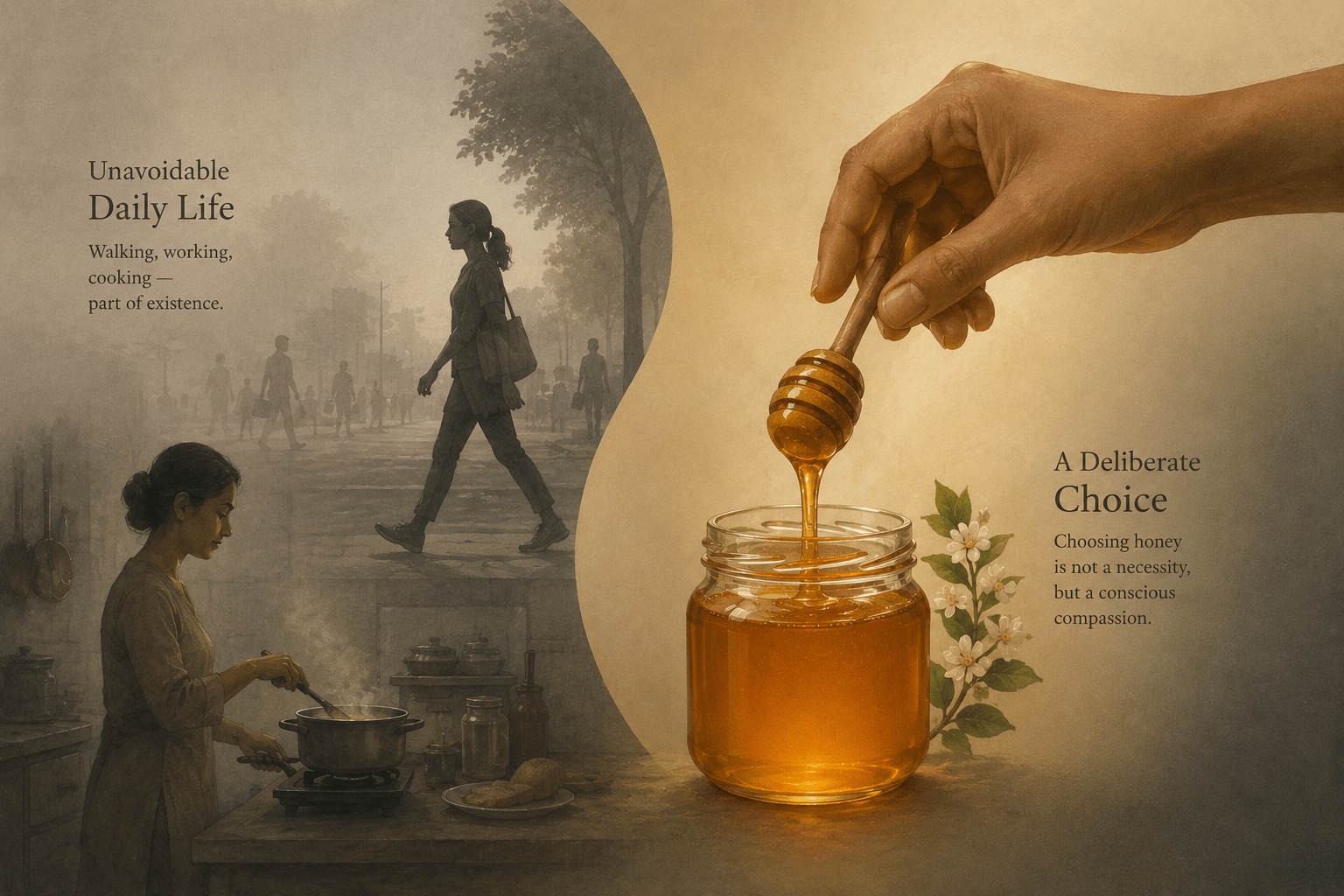
One thing worth understanding clearly. Jain philosophy does not ask a householder to achieve zero harm in their daily life. That is not possible. Cooking, walking, farming, these all involve some unavoidable harm to small beings. This is called Arambhi Himsa, the harm embedded in the basic activities of living. The texts acknowledge it and do not demand its complete elimination from a householder’s life.
But consuming honey is not Arambhi Himsa. It is Sankalpi Himsa, intentional violence. Nobody needs honey to survive. It is a conscious choice to consume something that is directly tied to the mass destruction of four-sensed mobile beings. When you choose it knowing what it is, that choice and its karmic consequence are entirely yours.
This is the distinction that makes honey non-negotiable even for a householder who is not expected to be perfect. The harm here is not embedded in daily necessity. It is chosen freely. And that makes all the difference.
Back to the Ads
When I think about those childhood honey advertisements now, I do not feel angry. They were selling a feeling. Health and nature and sweetness. They were not lying about the taste.
They just were not telling you what was inside the jar.
Now I know what is inside it. The four-sensed beings whose bodies produce it. The beings that live within the substance itself in their countless numbers. The karmic weight that Acharya Amritchandra, Acharya Samantabhadra, Acharya Kundakunda, and Acharya Amitgati all describe with complete consistency across different texts written centuries apart.
And that knowledge has changed not just what I eat but what I buy, what I put on my skin, and what I choose to bring into my life.
Not out of fear. Out of understanding.
The question is not whether honey tastes good. Of course it does. The question is whether that taste is worth what you now know it costs.
References:
- Purusharthasiddhyupay by Acharya Amritchandra, Gathas 69, 70, and 71.
- Ratnakarand Shravakachar by Acharya Samantabhadra, Verses 66 and 84.
- Panchastikaya by Acharya Kundakunda, Gatha 116.
- Amitgati Shravakachar by Acharya Amitgati, Verses 27/375, 28/376, and 32/380.