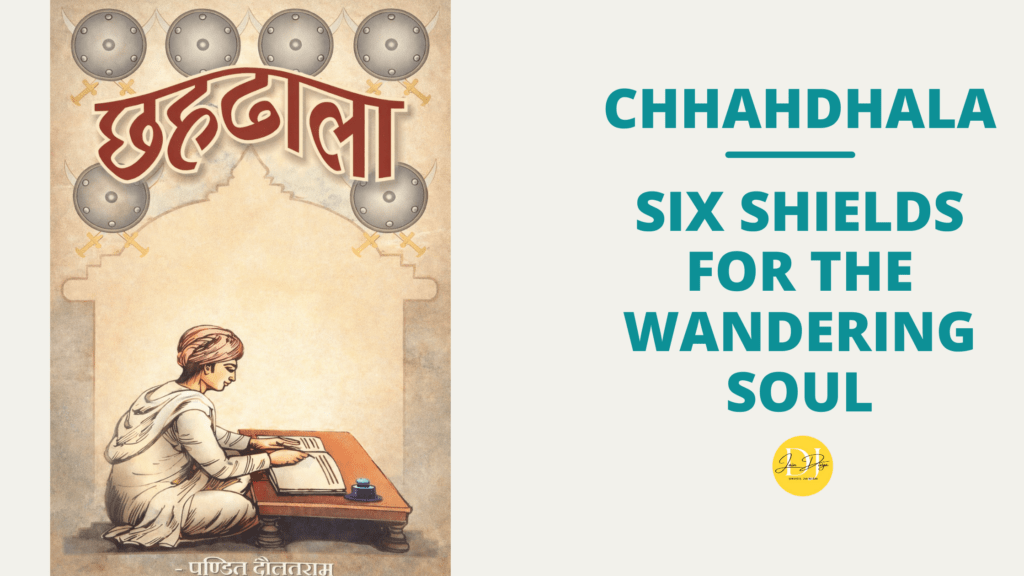
Composed in 1834 by Pandit Daulatramji, Chhahdhala is a compact yet profound Jain text that addresses one central human question:
Why does the soul, despite having everything, remain restless?
The word Chhahdhala means “Six Shields.” Each Dhala (chapter) functions as a protective layer—shielding the soul from Mithyatva, attachment, and inner disturbance. Though often called a “small Samayasara,” Chhahdhala stands on its own as a practical guide for spiritual clarity in daily life.
Dhalas 1 & 2: The Root of Suffering—Mithyatva
Chhahdhala begins by stating a truth that feels timeless:
Every living being desires sukha (happiness) and fears dukha (pain).
Yet life continues to feel incomplete.
In the First Dhala, Pandit Daulatramji describes the soul’s endless wandering (sansar bhraman). Whether as animals driven by instinct, celestial beings consumed by comparison and jealousy, or humans distracted by youth, wealth, and pleasure—the soul remains dissatisfied.
The Second Dhala identifies the core reason: Mithyatva.
Mithyatva is not mere ignorance.
It is a fundamental error of identity—believing:
- “I am this body.”
- “I am my caste, status, achievements, or possessions.”
- “Happiness lies outside me.”
As long as the soul mistakes itself for the non-soul (ajiva), suffering is unavoidable. This misidentification becomes the root cause of karmic bondage.
Dhalas 3 & 4: Reorientation of Vision—Samyag Darshan & Samyag Gyan
Once Mithyatva is recognized, the possibility of liberation begins.
The Third Dhala introduces Samyag Darshan—Right Faith.
This is not blind belief but correct perception:
the deep inner conviction that “I am a pure, conscious soul, separate from body and possessions.”
Here, Chhahdhala explains the Seven Tattvas—Jiva, Ajiva, Asrava, Bandha, Samvara, Nirjara, and Moksha. These principles act as a spiritual map, showing how karma flows into the soul and how it can be stopped and shed.
The Fourth Dhala focuses on Samyag Gyan—Right Knowledge.
Knowledge here is not accumulation of facts, but clarity that removes confusion.
For householders, Chhahdhala emphasizes Anuvrats—small vows that gradually weaken attachment and violence. Truthfulness, restraint, non-violence, and limitation of possessions are not moral rules but tools for inner stability.
Dhala 5: Inner Stability Through Bhavnas
Life remains unpredictable, even with the right faith and knowledge. To remain steady, Chhahdhala offers Twelve Bhavnas—deep contemplative reflections.
These Bhavnas are not pessimistic thoughts; they are clarifying lenses.
- Anitya Bhavna: Awareness of impermanence reduces arrogance and fear.
- Asuchi Bhavna: Understanding the body’s nature curbs obsession and pride.
- Ekatva & Anyatva Bhavna: Realizing the soul’s aloneness builds inner strength.
Together, these Bhavnas act as a discipline of awareness, preventing emotional extremes and cultivating equanimity (samata).
Dhala 6: The Ideal of Complete Freedom
The final Dhala presents the life of a Digambar Muni—a soul who has eliminated external and internal possessions.
This is not meant as a social instruction for everyone but as a spiritual direction. It shows the natural culmination of Samyag Darshan, Samyag Gyan, and Samyag Charitra.
Such a soul progresses toward the state of Siddha—free from karma, birth, and suffering. Here, the soul exists in its natural state of infinite knowledge, perception, bliss, and energy.
Why Chhahdhala Remains Timeless
Chhahdhala does not demand renunciation—it demands clarity.
- It defines success as nirakulata (inner calm)
- It addresses stress at its root, not at the surface
- It aligns ethical living with spiritual progress
- It speaks equally to children, householders, and seekers
In essence, Chhahdhala teaches that liberation does not begin in forests or monasteries—it begins in correct understanding.
The six Dhalas together form a complete spiritual path:
- From Mithyatva to Samyag Darshan
- From confusion to clarity
- From restlessness to freedom
For a soul tired of wandering, Chhahdhala offers not comfort but direction.