There is a particular kind of tiredness that comes not from working hard but from explaining yourself. I know it well.
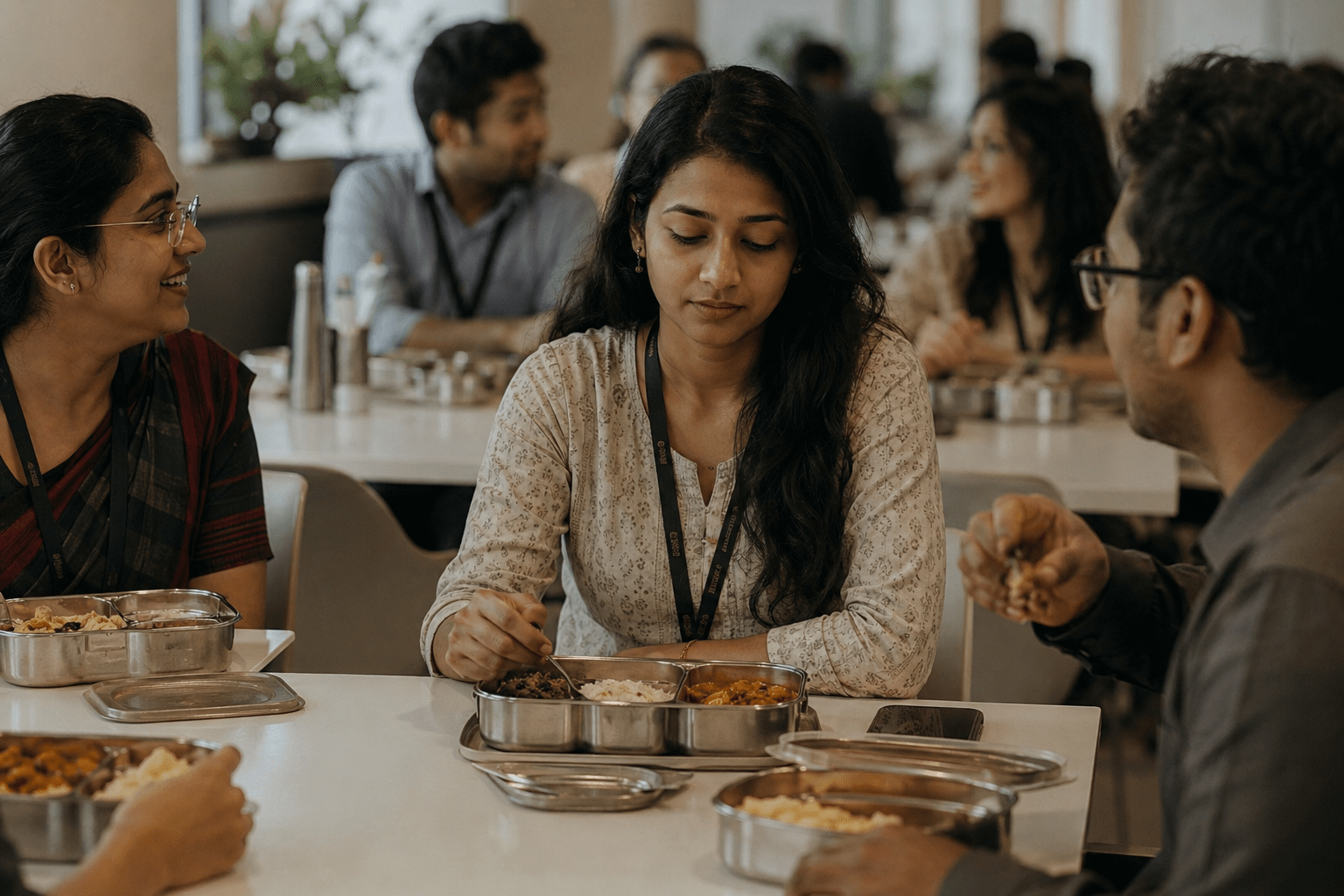
I worked in an office. And at some point, as happens in every Indian office, the lunch conversation turned to food. Someone noticed I was not eating the potato dish. Then came the questions. Then came the debate. And then, as it always does, it arrived at those four words that are meant to end every conversation: my body, my choice.
And they are not wrong. It is their body. It is their choice. I respect that completely.
But here is what exhausted me that day, and honestly exhausts me every time this conversation happens. It was not that they disagreed with me. It was that the violence I was trying to describe felt too small even to register. A potato. Some organisms are inside it. Infinite souls. The moment I said anything close to that, I could see it in their eyes. The quiet dismissal. The polite smile that means: you cannot be serious.
How do you explain infinity to someone who is not sure a potato is even fully alive?
I didn’t have a clear answer that day. I fumbled through something about our scriptures and our tradition and I could hear how weak it sounded even as I said it. My colleague nodded generously and changed the subject.
That conversation stayed with me. Not because I was wrong, but because I could not yet say clearly why I was right.
This article is the answer I wish I had given.
Let Me First Upgrade the Question
Because the way this debate usually goes, it stays at the wrong level. Root vegetables versus other vegetables. Jain rules versus personal freedom. That framing keeps both sides stuck.
The real question is something much more interesting. What does Jain philosophy understand about the nature of life that most of us, including me on that lunch break, struggle to communicate in a two-minute conversation?
Because this is not an arbitrary food rule. It is the logical conclusion of a philosophy that takes the question of what counts as a living being more seriously than almost anything else I have ever encountered. Once you understand that foundation, the potato makes complete sense. You do not need faith to accept it. You just need to follow the argument honestly.
What Modern Science Has Been Quietly Saying
Before I open the scriptures, let me share something that genuinely surprised me when I first came across it.
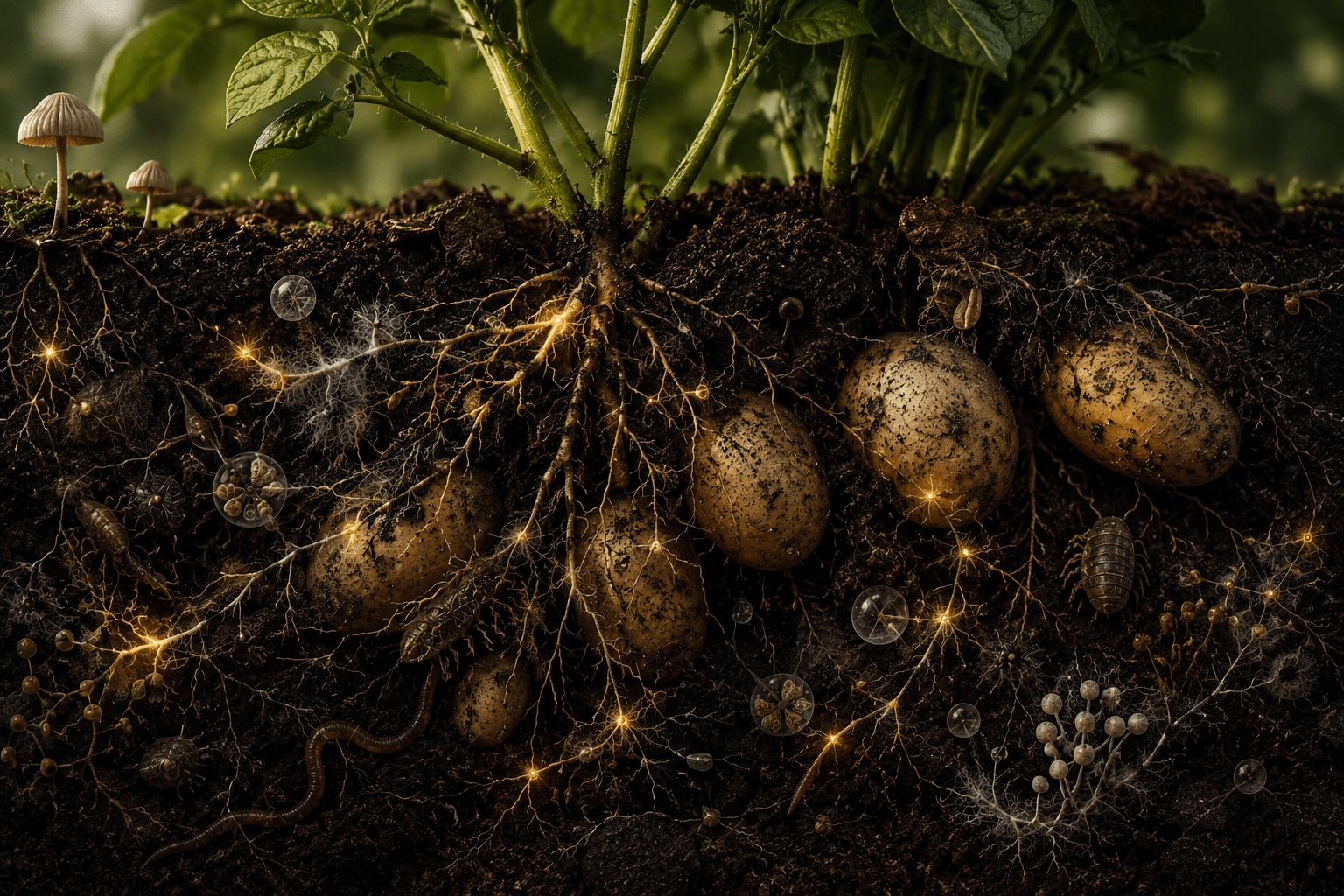
A single gram of healthy soil contains somewhere between one hundred million and one billion microbial organisms. Root vegetables do not just sit in this environment. They grow through it, draw from it, and are structurally part of it in a way that a fruit hanging from a branch simply is not.
In recent decades, plant biologists have documented something called the mycorrhizal network, a vast underground web of fungal threads through which plants exchange nutrients and even chemical signals across remarkable distances. What looks like a single potato to the eye is, at the biological level, a node inside an extraordinarily dense living system.
Researcher Stefano Mancuso at the University of Florence has shown that plants respond to injury through electrical signalling that travels through their root systems. The underground part of a plant is not its passive, inert anchor. It is its most biologically active zone.
Now I am not saying modern science has proven the Jain position. That would be an overreach. What I am saying is that the intuition that root vegetables represent a categorically denser concentration of life than aerial vegetables is not superstition. It is directionally consistent with what rigorous biology now understands about how life organises itself underground.
The Jain tradition arrived at this same intuition not through microscopes but through philosophy. And it arrived there more than a thousand years earlier.
Ananthkay: One Body, Infinite Souls
Acharya Amritchandra, the tenth-century Digambara scholar whose Purusharthasiddhyupay is one of the most logically rigorous texts on householder ethics in all of Indian philosophy, addresses this directly.
In Verse 162, he writes:
एकमपि प्रजिघांसुर्निहन्त्यनन्तान्यतस्ततोऽवश्यम् । करणीयमशेषाणां परिहरणमनन्तकायानाम् ।।162।।
Ekamapi prajighāṃsur nihanti anantāni atastato’vaśyam, karaṇīyam aśeṣāṇāṃ pariharaṇam anantakāyānām.
One who desires to destroy even a single ordinary plant body inevitably kills infinite souls. Therefore, the complete renunciation of all Ananthkay plants is absolutely necessary.
What strikes me every time I read this verse is its structure. Acharya Amritchandra is not issuing a decree. He is walking you through a consequence. The word he uses is Avaśyam, which means absolutely, necessarily, without exception. There is no softening. There is no wherever possible or wherever convenient. The reasoning leads to one conclusion and he states it plainly.
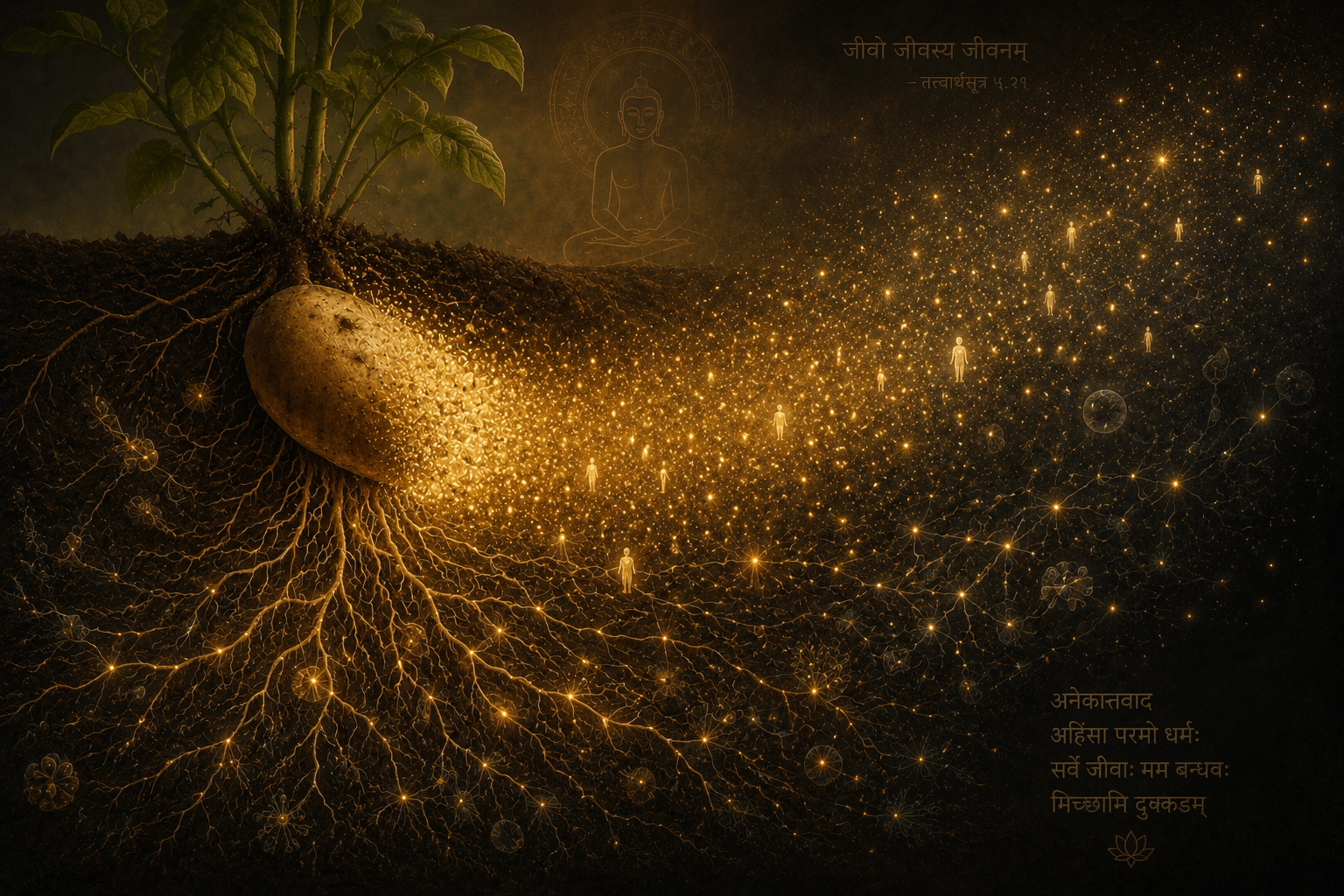
The category he describes is called Ananthkay. Anant means infinite. Kay means body. One body, infinite souls. These are plants where a single physical form houses not one soul but infinite souls, compressed within nested clusters of consciousness called Nigod. The philosophical position is specific: the number of souls within a single root vegetable exceeds even the total number of all liberated souls, all the Siddhas who have ever attained Moksha across infinite time.
I think about this every time someone dismisses root vegetable avoidance as a minor cultural quirk. We are not talking about one organism. We are not even talking about thousands. We are talking about a scale of life that the human mind genuinely struggles to hold.
Alpaphala Bahu Vighata: Minimal benefit, Immense destruction
Acharya Samantabhadra, whose Ratnakarand Shravakachar is the definitive scriptural guide for Jain laypeople, approaches the same prohibition from a direction I find particularly powerful because it does not require you to accept any metaphysical position first. It is a straightforward ethical argument.
In Verse 85, he writes:
अल्पफलबहुविघातान्मूलकमाद्राणि शृङ्गवेराणि ।
नवनीत निम्बकुसुमं कैतकमित्येवमवहेयत् ।।85।।
Alpaphala bahuvighātān mūlakam ādrāṇi śṛṅgaverāṇi,
navanīta nimbakusumaṃ kaitakam ityevam avaheyat.
Root vegetables, wet ginger, fresh butter, neem flowers, and ketaki flowers yield very little benefit but involve the destruction of many lives. Because of this, they must be entirely abandoned.
Alpaphala Bahu Vighata. Minimal benefit, immense destruction.
This is the principle I wish I had in my pocket that day at lunch. Because it does not ask anyone to believe in Nigod or Ananthkay upfront. It just asks a simple question. When you weigh what you gain from eating something against what is destroyed in the gaining of it, does this transaction make ethical sense?
For root vegetables, Acharya Samantabhadra’s answer is clear. The nutritional and sensory benefits are modest and entirely replaceable. The scale of destruction is, by the Jain understanding of life, staggering. The transaction does not hold up. And so these items are described as Abhakshya, completely unfit for consumption.
I also want to point out something about how this verse is constructed. Acharya Samantabhadra gives you the principle first and then illustrates it with specific items. That means Alpaphala Bahu Vighata is not just a rule about potatoes and ginger. It is a framework that a thoughtful Shravak can apply independently to new situations. That is the sign of a living philosophy, not a static list of dos and don’ts.
Difference Between a Monk and Someone Like Me
I want to address something honestly because I think it is the real reason most people give up on this conversation quickly.
The assumption is that Jain dietary practice is all or nothing. Either you follow everything perfectly, or the whole thing is meaningless. The scriptures themselves are far more nuanced than this.
Jain ethics divides its vows into two categories. Mahavratas are the great vows for ascetics who have renounced worldly life entirely. Anuvratas are the partial vows for householders, for people like me who are navigating offices, families, deadlines, and lunch conversations.
For an ascetic, the renunciation of violence is total. For a householder, it is graduated. The texts acknowledge honestly that someone living in the world cannot avoid all harm to single-sensed beings. That unavoidable harm is understood and accounted for within the system.
But here is where the texts draw a firm line. Even if a householder cannot give up all plant life, they must give up Ananthkay. Because the scale of violence involved in root vegetables is so disproportionate, infinite souls destroyed for the pleasure of one meal, that even a partial vow must include their complete renunciation. This is the minimum the path requires of someone who has genuinely committed to it.
When my colleague said, ” My body, my choice”, she was right about one thing. This path is a choice. Nobody is forcing it. But when you understand what that choice actually involves, it stops feeling like a restriction and starts feeling like the only coherent option.
The Real Violence
Everything I have shared so far is about the external dimension of this practice. What you eat, how many souls are involved, and what the Acharyas established. But the tradition consistently insists that the external dimension is only half the picture.
Acharya Amritchandra makes this clear in Verse 44:
अप्रादुर्भावः खलु रागादीनां भवत्यहिंसेति ।
तेषामेवोत्पत्तिर्हिंसेति जिनागमस्य संक्षेपः ।।44।।
Aprādurbhāvaḥ khalu rāgādīnāṃ bhavaty ahiṃseti,
teṣām evopattiḥ hiṃseti jināgamasya saṃkṣepaḥ.
The non-appearance of passions like attachment and aversion is Ahimsa. Their very manifestation is Himsa. This is the essence of the entire Jain teaching.
This verse stopped me the first time I really sat with it. Ahimsa is not primarily about what your hands do. It is about the internal state that drives your hands. If craving and attachment are running your choices, you are already in a state of Himsa before you have touched anything.
He builds on this in Verse 43:
यत्खलु कषाययोगात्प्राणानां द्रव्यभावरूपाणाम् ।
व्यपरोपणस्य करणं सुनिश्चिता भवति सा हिंसा ।।43।।
Yat khalu kaṣāyayogāt prāṇānāṃ dravyabhāvarūpāṇām,
vyaparopaṇasya karaṇaṃ suniścitā bhavati sā hiṃsā.
The destruction of the material and spiritual vitalities of beings through activities driven by passions is definitively established as Himsa.
Pramada: The negligence
And then in Verse 48, he introduces Pramada, the concept we often forget in daily life:
हिंसाया अविरमणं हिंसा परिणमनमपि भवति हिंसा ।
तस्मात्प्रमत्तयोगे प्राणव्यपरोपणं नित्यम् ।।48।।
Hiṃsāyā aviramaṇaṃ hiṃsā pariṇamanam api bhavati hiṃsā,
tasmāt pramattayoge prāṇavyaparopaṇaṃ nityam.
Not abstaining from violence is Himsa. Acting violently is also Himsa. Therefore, in Pramatta Yoga, negligent conduct driven by carelessness and passion, the destruction of life is continuous and unending.
Pramada. Spiritual negligence. Going through life on autopilot, driven by habit and craving, without ever stopping to ask what you are actually doing and what it costs.
This is the real indictment of eating root vegetables, and honestly, it is the indictment that sits with me the most. It is not only that a potato contains infinite souls. It is that reaching for it without thought, purely out of habit and taste preference, is itself the problem. You are asleep in your own life. You are making choices that have consequences you have never stopped to examine.
But We Are Not Monks
I hear you. I am not a monk either.
The entire Anuvrata system exists precisely because Jain philosophy understood that householder life involves compromises that monastic life does not. The texts do not demand perfection. They demand consciousness.
And the truth about root vegetables, specifically, is that the sacrifice is not actually large. You do not need potatoes. You can eat squash, raw banana, lentils, leafy greens, corn, and dozens of things that involve a fraction of the karmic weight. As Acharya Samantabhadra makes clear through Alpaphala Bahu Vighata, when the benefit is minimal and the harm is immense, the choice is not actually difficult. It only feels difficult because habit makes it feel necessary.

The Answer I Wish I Had Given
I think about that lunch conversation sometimes. My colleague was not a bad person for asking. She was genuinely curious. And I was not wrong for believing what I believe. I just did not yet have the words to carry the weight of what I was trying to say.
If I could go back, here is what I would tell her.
It is not about the potato. It is about what kind of attention I want to bring to my own life. It is about a tradition that sat with the question of what counts as life, followed that question honestly wherever it led, and arrived at conclusions that were uncomfortable and precise and impossible to dismiss once you actually understood them.
You are right that it is my body and my choice. And I have chosen not to be asleep to what my choices cost. That is all this is.
She might still not agree. That is fine. But at least the conversation would have been a real one.
References:
- Purusharthasiddhyupay by Acharya Amritchandra, Verses 43, 44, 45, 48
- Ratnakarand Shravakachar by Acharya Samantabhadra, Verse 85