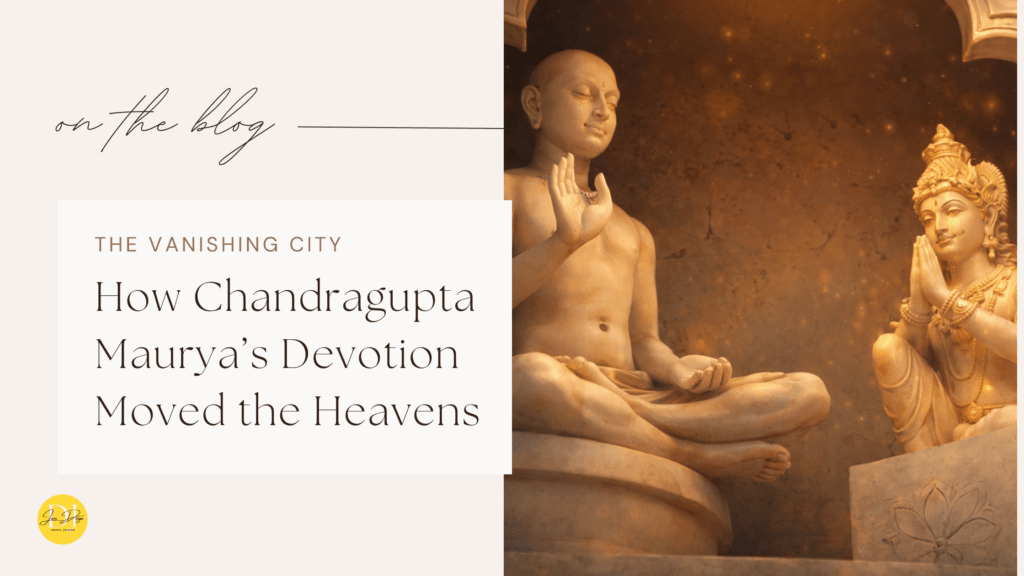
The sun rose quietly over the Chandragiri hills. Birds stirred, the forest breathed—but for the monk who had once ruled an empire, the world was slowly fading into hunger and prayer.
Chandragupta Maurya had given up everything.
The crown.
The palace.
The power that once bent nations.
In their place, he held a simple peacock-feather brush. Instead of silk and stone, he lived in a cold cave deep in the southern forests. His guru, the great saint Bhadrabahu, had already left his body. Now Chandragupta stood alone—no kingdom behind him, no teacher beside him—only his vows and his soul.
He was living the life of Kantara-charya, the harsh discipline of a forest monk.
To survive, he had to beg for food. But not just any food. According to the Jain path, it had to be perfectly pure. It could not be cooked for him. It could not come from pride, attachment, or desire. One wrong step—and his lifelong discipline would break.
The Days of Testing
It is said that the heavens themselves wanted to know:
Was this former emperor truly ready to live as a saint?
A celestial being, a Yakshini, appeared—not to bless him, but to test him. She placed Antarayas, obstacles, in his path.
On the first day, Chandragupta walked toward the East.
He met a woman wearing heavy gold bangles that clinked loudly as she moved. She offered him rich food, her eyes filled with pride. Chandragupta understood immediately. Accepting food born from display and ego would poison his vows. He bowed silently and walked away.
His stomach burned with hunger.
On the second day, he went North.
A large kitchen appeared in the forest, overflowing with sweet juices and warm food. But there were no homes, no families—just abundance with no life around it. His senses were tempted, but his mind stayed clear. This was not natural. This was illusion. He turned away again and returned to his cave, weaker than before.
On the third day, he walked West.
A lone woman stood there, holding a simple clay pot. She was gentle and sincere. But Jain discipline is precise. A monk does not accept food from a woman alone in a forest—for the protection of both. Chandragupta was trembling now, close to collapse, yet he chose his vows over his body.
Three days.
No food.
Only faith.
The Miracle of the City
On the fourth day, Chandragupta could barely walk. Each step felt like his last. He turned South, praying not for food, but for the strength to remain true.
Then something extraordinary happened.
The dense forest opened.
Before him stood a beautiful city—clean streets, white houses, calm faces. Men and women, devoted Jain householders, stood quietly at their doors. Their eyes held no pride, no excitement—only reverence. They offered him simple, pure food, exactly as the scriptures described.
For the first time, Chandragupta accepted a meal.
It was not just food.
It was divine ahar—nourishment given by the heavens itself.
The Vanishing Truth
The truth of this miracle was revealed by a young monk, a Kshullak, traveling nearby with the group of Acharya Visakhanandin.
Curious, he followed the path that led to the city. In his haste, he hung his wooden water pot—his kamandalu—on a tree branch near one of the houses. Later, realizing he had forgotten it, he rushed back.
But the city had disappeared.
The houses.
The people.
The streets.
Gone.
Only the silent forest remained.
In the middle of it stood a single tree. Hanging from its branch was his water pot—still full. When he drank from it, the water tasted sweeter than anything he had ever known.
When he told his teacher what he had seen, Acharya Visakhanandin smiled and said,
“The celestial beings created that entire city for Chandragupta alone.
Because he refused to break his vows for three days, the heavens had no choice but to build a world pure enough for him to eat in.”
Chandragupta had once ruled a vast empire.
Now, having renounced it completely, the universe itself bent quietly—just enough—to keep his spirit alive.
References:
- भद्रबाहु–चाणक्य–चन्द्रगुप्त–कथानक एवं राजा कालिक वर्णन — Jain historical text by Mahakavi Radhakr̥t, edited by Dr. Rajaram Jain, documenting the Bhadrabahu–Chandragupta Maurya tradition. Available at:
https://jainworld.jainworld.com/JWHindi/Books/Sahjanand+Shastramala/Charitra/2015.424224.BhadrabahuCharitra1992AC6474.pdf