The Namokar Mahamantra is the most sacred and foundational prayer in Jainism. It is usually the first mantra taught to Jain children and often the last remembered in moments of reflection. Unlike many prayers, the Namokar Mantra is not addressed to a creator, god, or personal deity. Instead, it is a salutation to spiritual excellence itself—to souls who have attained perfection or are guiding others toward liberation.
At its core, the mantra reflects Jainism’s emphasis on self-effort, inner purity, and reverence for virtues rather than personalities.
The Fivefold Salutation (Panch-Parmeshthi)
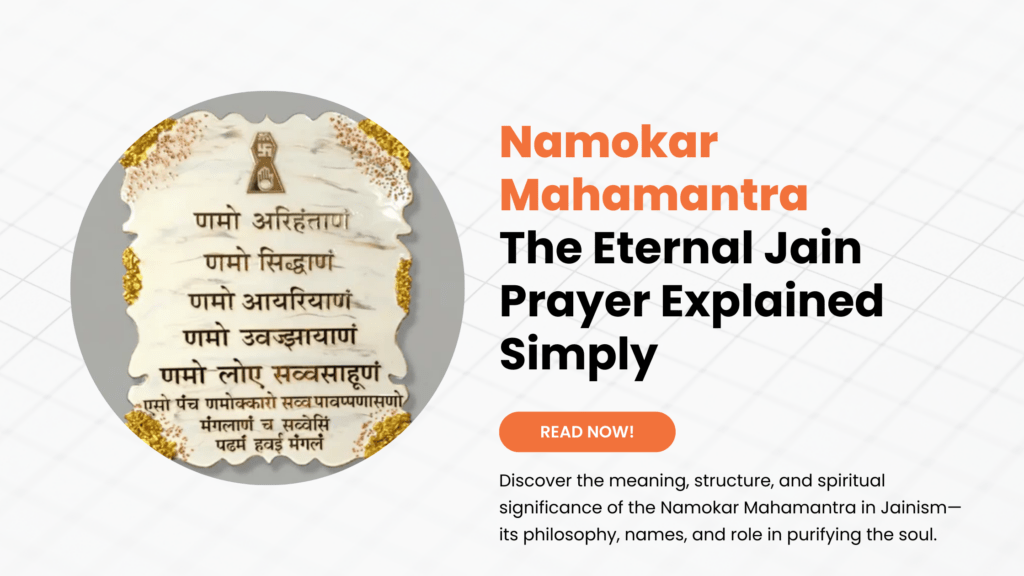
The Namokar Mantra consists of five lines, each bowing to a distinct spiritual ideal:
- Namo Arihantanam – Salutations to the Arihantas, enlightened beings who have conquered inner enemies such as anger, pride, deceit, and greed, and have destroyed destructive karmas.
- Namo Siddhanam – Salutations to the Siddhas, fully liberated souls who have shed all karmic bondage and exist in a state of eternal bliss and knowledge.
- Namo Aayariyanam – Salutations to the Acharyas, spiritual leaders who uphold and teach right conduct.
- Namo Uvajjhayanam – Salutations to the Upadhyayas, scholars and teachers who preserve and explain Jain scriptures.
- Namo Loe Savva Sahunam – Salutations to all Sadhus and Sadhvis in the world who are sincerely walking the path of liberation.
This fivefold bow is regarded as the most auspicious mantra, believed to weaken sinful tendencies and purify the soul.
A Prayer Without Demands
One of the most profound aspects of the Namokar Mantra is its selflessness. There are no wishes for wealth, health, or success. There is no plea for protection or favor. The mantra simply expresses reverence.
Importantly, it bows not to individuals by name, but to qualities and spiritual states. Any soul—past, present, or future—who embodies these virtues is automatically included. This makes the mantra universal, timeless, and deeply ethical.
Eternal Yet Historically Recorded
The Namokar Mantra is considered Anadi-Nidhan—without beginning or end—because it salutes eternal spiritual truths. At the same time, Jain tradition records that it was first written down as a mangalacharan (auspicious opening) by Acharya Pushpadant in the scripture Shatkhandagam around the 2nd century.
This dual understanding beautifully reflects Anekantavada, the Jain principle of multiple viewpoints: the mantra is eternal in essence, yet historically documented in time.
Structure, Language, and Technical Details
- Language: The mantra is composed in Prakrit, making it accessible and rhythmic.
- Meter: It follows the Arya poetic meter.
- Composition: Traditionally counted as 35 letters and 58 matras.
- Om as Essence: The sacred sound “Om” is considered a condensed form of the mantra, derived from the initials of Arihant, Ashariri (Siddha), Acharya, Upadhyaya, and Muni.
- Chanting Practices: Commonly recited 9 or 108 times, using mental chanting, finger counting (kar-jap), visualization techniques, or a mala.
Mental chanting (maanas jaap) is especially valued for its depth and focus.
Names of the Namokar Mahamantra and Their Significance
- Anadinidhan Mantra (अनादिनिधन मंत्र)
Signifies that the mantra is eternal—without beginning or end. Though written down in the Shatkhandagam, it is timeless because it bows to the eternal spiritual states of the Panch-Parmeshthi, reflecting the Jain principle of Anekantavada. - Aparajit Mantra (अपराजित मंत्र)
Known as the “undefeated mantra,” it represents spiritual protection and the belief that its power cannot be overcome by negative forces or obstacles. - Maha-Mantra (महामंत्र)
Called the great mantra because it is considered the highest and most complete expression of Jain philosophy in its purest form. - Mool Mantra (मूल मंत्र)
Regarded as the root mantra from which all other mantras arise. Jain tradition states that 84 lakh mantras originate from the Namokar Mantra. - Mrityunjay Mantra (मृत्युञ्जय मंत्र)
Identified as the conqueror of death, as sincere meditation on this mantra helps the soul transcend the cycle of birth and death and move toward moksha. - Adi Mantra (आदि मंत्र)
Considered the first and foremost mantra, recited before all auspicious activities in Jain spiritual practice. - Mangal Mantra (मंगल मंत्र)
The most auspicious prayer in Jainism, believed to purify karmas, strengthen right faith, and bring inner well-being. - Tarantaran Mantra (तरणतारण मंत्र)
Describes the mantra as a means to cross the ocean of worldly existence (samsara) and support others on the same path. - Sarvasiddhidayak Mantra (सर्वसिद्धिदायक मंत्र)
Believed to bestow all accomplishments, with emphasis on spiritual attainments rather than material gains. - Keval Gyan Mantra (केवल ज्ञान मंत्र)
Recognized as a medium that ultimately guides the soul toward Keval Gyan, the state of infinite knowledge. - Navkar / Namaskar Mantra (नवकार / नमस्कार मंत्र)
The most commonly used names, highlighting the mantra as a prayer of salutation—bowing to virtues and spiritual qualities rather than individual identities.
Spiritual and Practical Impact
Jain texts describe the Namokar Mantra as the source from which countless other mantras arise. It is believed to calm the mind, reduce inner agitation, and prevent the influx of new karmas. Rather than erasing past actions, it protects the soul from further entanglement, much like a watchman who prevents new thefts even if old losses remain.
Stories from Jain tradition—whether symbolic or historical—illustrate its transformative influence on humans and even animals, emphasizing faith, discipline, and inner change over miracles.
Why the Namokar Mantra Matters Today
In a world driven by desire and constant asking, the Namokar Mantra teaches reverence without expectation. It gently shifts attention away from outcomes and toward ideals—purity, discipline, humility, and self-realization.
Chanting it regularly is not about gaining something external; it is about becoming inwardly aligned with the highest possibilities of the soul.
References
- JinSwara. (n.d.). All you need to know about Namokar Mantra | Jainism basics [Video]. YouTube.
- Balbodh Guide. (n.d.). Balbodh guide (Digambar Jain text). Jain eBooks. https://www.jainebooks.org
- Prashantsagar, M. (n.d.). Jina Saraswati (जिन सरस्वती). Jain religious publication.
- Bharill, H. (n.d.). Ṇamōkāra Mahāmantra: Ēka anuśīlana (णमोकार महामंत्र : एक अनुशीलन). Pandit Todarmal Smarak Trust.